ISLAMABAD: Sindh, Balochistan and Khyber Pakhtunkhwa on Monday opposed a proposed change in natural gas distribution formula that could benefit household consumers in Punjab and affect industrial and commercial consumers in other provinces.
At a meeting presided over by Minister for Petroleum and Natural Resources Shahid Khaqan Abbasi, the three provinces also accused the centre of violating their constitutionally protected right to have control over gas they produce.
The minister convened the meeting for brainstorming on redefining the natural gas allocation policy to treat equally all the residential consumers across the country irrespective of gas produced in one province or the other before seeking its approval from the forthcoming meeting of the Council of Common Interests (CCI).
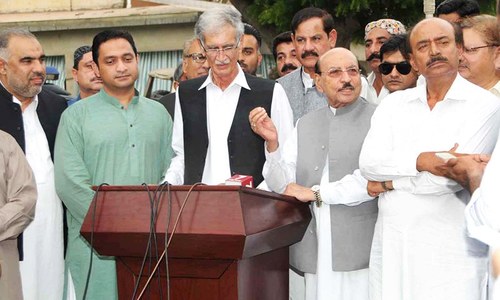
The meeting was also attended by Federal Minister for Inter-Provincial Coordination (IPC) Riaz Hussain Pirzada, Chief Minister Balochistan Sanaullah Zehri and representatives of the Sindh and KP governments.
A spokesman for the petroleum ministry when approached said he had been barred from releasing any information regarding the meeting to the media except a photograph.
Informed sources, however, said the centre was seeking dedication of natural gas produced in all provinces to residential consumers as a “first priority” to overcome acute winter shortages, instead of current arrangement of gas supply that allowed provincial governments to let all consumer sectors in that province where it is produced as enshrined in Article 158 of the Constitution.
Mr Abbasi, these sources said, argued that Pakistan was a federation and natural gas should be provided to all its citizens. “All domestic consumers should be treated as equals irrespective of their provincial location,” he was quoted as saying.
The sources said smaller provinces accused the federal government of violating their constitutional rights on the issue of gas consumption even at present. For example, KP has been criticising the centre for creating hurdles in utilisation of 100 million cubic feet per day (mmcfd) of natural gas developed after the 18th Amendment to the Constitution for establishment of power plant.
The petroleum ministry also proposed that after meeting needs of the domestic consumers with domestically produced gas, surplus should be left at the provincial discretion on the basis of production.
It also proposed that liquefied natural gas (LNG), whose quantity would keep on increasing with time, could be shared with the provinces as far as their commercial, industrial and compressed natural gas (CNG) requirements were concerned.
The nutshell of the response from the three smaller provinces was that they would not surrender their rights that were protected under Article 158 of the Constitution. Balochistan pointed out that the said article remained part of the original 1973 constitution but was activated at the time of the 18th amendment four decades later when its gas production had declined drastically.
The provinces opposed any change to the gas allocation because it appeared to have been designed to benefit consumers in Punjab.
At 68pc, Sindh has the largest share in overall gas production of the country, followed by around 15pc in Balochistan, 5pc in Punjab and around 12 pc in KP. Consumption-wise, Punjab tops the list with 45pc share, followed by about 42pc in Sindh, 7pc in KP and 6pc in Balochistan.
The petroleum ministry believes that the CCI should adopt the new arrangement to ensure that domestic gas is supplied to all the residential citizens as a top priority because the gas shortage had now expanded to all the provinces and all need to find a solution together on a permanent basis.
This would be a departure from the existing arrangement under which provincial government could provide fresh gas finds to industrial, commercial and CNG sectors within their provincial territories even if domestic consumers of other province, particularly Punjab, face serious shortages.
Punjab’s domestic consumers currently face over 40pc gas shortage in winters. Gas supply in Punjab at present is about 60pc of demand in the residential sector and there is no gas for any other category of consumers who are now being supplied imported LNG.
The ministry has been at odds with the Sindh government for gas supply to CNG stations while domestic consumers in Punjab suffer. Likewise, there is no gas load-shedding for CNG consumers in KP and Balochistan at present.
Published in Dawn, July 26th, 2016