



Directed by James McTeigue and scripted by Andy and Lana Wachowski, the film stars Natalie Portman (Evey Hammond), Hugo Weaving (V), Stephen Rea (Inspector Eric Finch), Stephen Fry (Gordon Deitrich) and John Hurt (Chancellor Adam Sutler). It is also pertinent to mention that V for Vendetta is inspired from a 1980s-era graphic book series of the same name, which was written by Alan Moore and illustrated by David Lloyd. As with most film adaptations of books, McTeigue’s film departs from the original series in several ways, especially in the characterisations, the narrative and the climax. This is a possible explanation as to why the series’ writer, Moore, dissociated himself from the film.
The film begins with the following rhyme:
Remember, remember
The fifth of November
The gunpowder treason and plot.
I know of no reason
Why the gunpowder treason
Should ever be forgot.
It sets the tone of the film and points out the connection between the 1605 Gunpowder Treason Plot and the central storyline of V for Vendetta, in which this historical incident holds great significant. The main protagonist, known simply as V, wears a mask that is inspired from the traditional Guy Fawkes masks worn at the Guy Fawkes Night celebrations in England. But for V, the mask is a part of him, his entire identity. Traditionally, a mask is meant to conceal one’s identity, a function that V’s mask performs perfectly. Neither the characters, nor the viewer discover anything about V’s past, except for the few relevant details that shed light on his present self and his ‘vendetta’. Although Evey questions him about his family background and his life before he became V, she is given an unsatisfactory answer from him.

The viewer is informed briefly about V’s past through the breakfast scene between V and Evey at the former’s residence, Shadow Gallery. The skin on V’s hands is scarred with pink and white colourations, an indication to his past and the reason why every inch of his body is clothed and concealed. Although it is unclear at that point what had happened, V’s past life is revealed later in the flashbacks to his time in the Norsefire-owned Larkhill detention centre, where the inmates were injected with a biological weapon under experimentation. It was later used to kill thousands of people, and eventually became known as the St. Mary’s virus, which killed all the Larkhill inmates except V, who for some inexplicable reason developed resistance to it, as well as immense physical and mental strength that was to later help him in his vendetta. He had secretly worked towards blowing up the place under the pretext of gardening, and escaped from the burning ruins severely burnt, but alive and functioning perfectly well. Hence, one has the explanation as to why V keeps his physical self under wraps in his garb, which went on to become part of popular film merchandise.

The above example provides the explanation why V hides his face and identity (in conventional terms) but it does not speak for the genesis of the intellectual, political being that V embodies. Presumably, it was already a part of him before he was sent to Larkhill and emerged from there as the nameless, faceless dissident, hereafter known as V. However, he does admit to Evey that he had spent the years after his escape from Larkhill formulating his vendetta. Specifically, he only says that he had spent 10 years clearing a closed London Underground tunnel near the Parliament buildings, although one may assume that he worked on devising the other parts of his vendetta, while he was not digging away in the Underground tube tunnels.

V is a complex character because one does not know him, except for what we see and how we understand him. His identity is simultaneously shown and hidden; he embodies the dissident that starts the rebellion against oppression and injustice, motivates the dormant dissident that lies within each human being living quietly in oppression. And that is where the problem lies.

Despite inspirational memorable quotes like “Ideas are bulletproof” or “People should not be afraid of their governments. Governments should be afraid of the people”, V ends up developing romantic feelings for Evey, while also using her for his vendetta. The impact he has upon the viewer is lost halfway through the film when it becomes evident that V is in love with Evey, a needless thing to do, most likely a ploy to attract more viewers who wouldn’t watch a film like V for Vendetta otherwise. Indeed, the importance of the man called V, not the revolutionary idea he embodies, is emphasised by Evey in her voiceover speech at the beginning, probably a symbolic confession of her love for him. But the speech comes too early in the narrative and one may easily overlook it until later. She again brings it up at the climax, this time speaking to Inspector Finch, but by now it has already become irksome. The motivational nature of the sociopolitical lessons V for Vendetta teaches is, therefore, greatly diminished and one feels considerable annoyance as the credits start rolling.

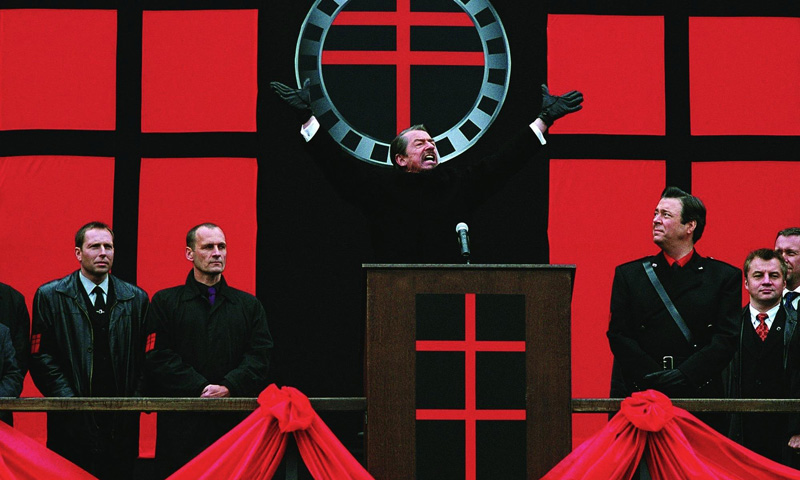
All the symbolism in the film might make the film entertaining at first, especially if one has no prior knowledge about the film. The extensive symbolism certainly helps in understanding the film, as well as keeping us engaged in finding patterns in the narrative. The most blatant piece of symbolism in the film is the allusion to Hitler and the Third Reich. But a comparison – just as obvious – is also made with the 9/11, the post-9/11 world and US’s war on terror with the Norsefire regime, as well as Islamophobia. This is one of the ways in which the film departs from the original graphic novel: its references to the events of the post-9/11 world in order to make it more relevant for the audiences today, evidently another ploy to attract sponsors and the attention of the public and the media. The comparison with Hitler and his regime, however, remains rather the same in both the graphic novel and the film. For a more detailed comparison of the comic book series and the film, see Hilary Goldstein’s article.
Hugo Weaving deserves a special mention because while the rest of the cast acts as they usually do, with their eyes, their faces and most of all, their expressions, Weaving only has his voice and his body language to use as devices to assume the persona of V, both the man, as well as the idea, and he does it perfectly.
One of the best films of its time, V for Vendetta is a must-watch – not because you may or may not agree with its sociopolitical message and like the fact that it challenges the people’s will to submit to authority and fear and inspires dissent – but because there is a chance that one may find something in the film to relate to. However, if you do watch the film or have already seen it, reading the original comic book series is highly advisable in order to have a more rounded opinion about the entire film and comic book franchise.



























