

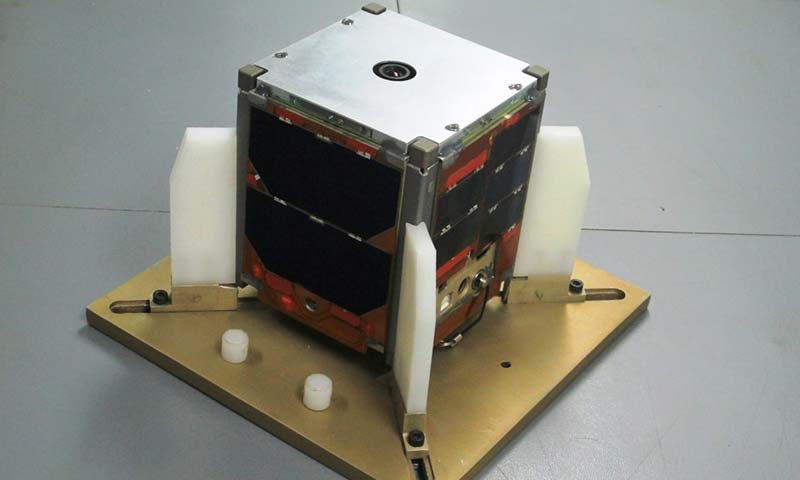



ISLAMABAD: Pakistan's first Cubesat satellite, iCUBE-1, was launched on Thursday on-board Dnepr launch vehicle from Yasny launch base in Russia.
Built by the Institute of Space Technology (IST), iCUBE-1 was designed and developed at a cost of Rs3-3.5 million.
Talking to Dawn.com, Spokesperson IST Raza Butt said that it’s a positive move for technology in Pakistan.
“The world is moving towards miniaturisation. The launch cost is significantly low for CubeSats as compared to the bigger satellites. The low cost factor is very attractive for researchers who can test their payloads using these cubesats and then incorporate this technology in their bigger satellites,” he commented.
For the uninitiated, a CubeSat is a type of miniaturized satellite for space research that usually has a volume of exactly one liter (10 cm cube), has a mass of no more than 1.33 kilograms.
The cubesat will open up a wide vista of future experiments that can be carried on cubesats in the domain of imaging, microgravity, biology, nano technology, space dynamics, chemistry, space physics and various other fields. Cubesats can also provide a test bed for developing satellite constellations for specific applications.
“In addition, CubeSats need to pass the standard testing procedures which are same for all other satellites giving it’s manufacturers the confidence of building and launching bigger satellites,” he informed.
A team of around 20 faculty members and 15 students worked on the project which was initiated in 2009.
ICUBE-1 is expected to be operational for a period of 2 years. It is a low earth polar orbit at an altitude of 600km.
Sharing an interesting observation during the development of the project, Butt said: “It was interesting that during launch integration, the team had interaction with developers from other countries, such as Italy, Spain, USA and Peru. They were excited. A number of them are open to collaboration with IST on future cubesat missions.”
APP adds:
The Institute of Space Technology has achieved this astounding success in a short span of ten years, owing to the concerted efforts by its leadership, students and faculty to standout in this field and to create a national center of excellence in space technology.
Vice Chancellor IST, Engr. Imran Rahman congratulated 'Team IST' for this great achievement.
He specifically thanked the Federal Minister for Planning, Development and Reforms, Prof. Ahsan Iqbal, Chairman HEC and Chairman of National Space Agency for their continuous encouragement, support and help in achieving this milestone.
Talking to APP, Spokesperson IST Raza Butt said “iCUBE-1 has been launched in a polar orbit, 600 Km above the surface of the Earth, and is designed to take low resolution images of Earth and other space objects.”
Initially, iCUBE-1 will transmit a Continuous Wave Morse coded beacon with message “iCUBE-1 First CubeSat of Pakistan”.
Amateur radio operators have a great opportunity to hear those signals on the VHF band. iCUBE-1 has a mass of 1.1 Kg and is thus categorized as a pico-satellite.
The satellite has a volume of 10cm cube and it houses several sensors to collect data for scientific purposes. iCUBE-1 is a fully autonomous satellite and is capable of maintaining its health via its on-board computer.
The satellite will send its health data to ground stations and can also be commanded from Satellite Tracking and Control Station at IST.


























