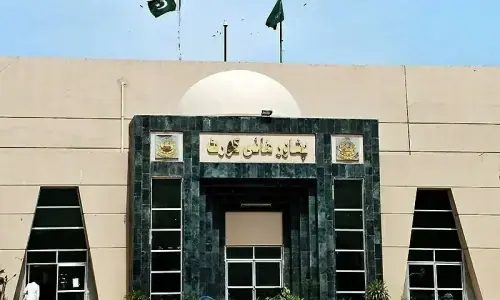
PESHAWAR: What a metaphor! A newspaper exhibits a photo of “replica of a cactus plant” installed along GT Road to “beautify” the city. Amazing!
Note the words “cactus plant” and “beautify”. Certainly we have travelled a long way to this wasteland, once was “a city of majestic Mughal gardens”. No more.
Peshawar is of course being “beautified” by our erstwhile city planners and administrators besides, installing giant sized replicas of cactus plants, fighter jets, rockets and missiles and what not, on main thorough fares. Hurtling towards desertification, the environmentalists and meteorologists have predicted, unprecedented heat waves followed by cloud bursts and floods are a reminder.
Pakistan and Afghanistan, according to some experts, sit atop an ecological volcano waiting to explode. The climate change is here and hitting us hard already. Hence, the cactus flower on GT Road intersection is perhaps a reminder of the ominous future. No other way to explain this harebrained idea!
An IUCN expert once commented: “Trees are the most convenient obstacles for city planners and administrators to get rid of. Any expansion or development does not proceed without denuding a few dozen or even hundreds of trees in the process”. While in the developed nations old trees are symbols of heritage and veneration.
Under the PTI government, we expected better sense but its business as usual for PDA and C&W with their hyperactive bulldozers and cranes removing all vestiges of old trees and replacing them with tacky fountains or some concrete monstrosity.
A city long obsessed with the “Dubai syndrome” lacks imagination about how to conserve old trees and plant huge indigenous shady trees. As an environmentalist, I have been long insisting on regular sensitisation programmes for C&W and PDA and other departments assigned with urban development.
During the last decades, our city administrators developed an obsession with imported palm and date trees (Dubai again!) normally suitable for arid climates. Having thrown away extravagant amount of taxpayers’ money, the surviving dead stumps along major roads remind us of this worthless enterprise.
Dr Asadullah, director of centre of plant biodiversity and botanical garden in Azakhel, Nowshera says: “For centuries indigenous species like Neem, Barh (Indian Banyan), Peepal (Bodhi tree), Jaaman, Mango and Kachnaar (camel foots tree), Sheeshum (Indian rose wood), Bakiyan (china berry), Sareek (silk tree), berries (Chinese apple), Keekar, Palosa, Amaltaas and so many others existed predating the Mughal, Durrani and British periods. These contributed to a unique biodiversity of colour, fragrance, shade, nesting and fruit for birds and squirrels and above all a temperate climate. No wonder large trees are considered lungs of the earth and even compared to nature’s air conditioner.”
This is unknown to our modern city managers, who are now opting for water (and labour) intensive fine grass and exotic plants for decorative purposes (Dubai certainly!) but do not serve the purpose of reducing the “urban heat island effect” of a populous cities like Peshawar with exploding population and smoke emitting vehicles. The solution is huge shady trees (PTI’s billion tree tsunami has yet to hit Peshawar!)
Meanwhile, the hapless citizens of Peshawar have to bear the fact that a historic city of gardens and flowers is now turning into a cultural and ecological desert. Cactus plant certainly serves as a suitable metaphor of sorts for Peshawar -- a cactus city in all respects, without shade, colour and fragrance.
(The writer is the founding member of Sarhad Conservation Network.)
Published in Dawn, July 18th, 2015
On a mobile phone? Get the Dawn Mobile App: Apple Store | Google Play