

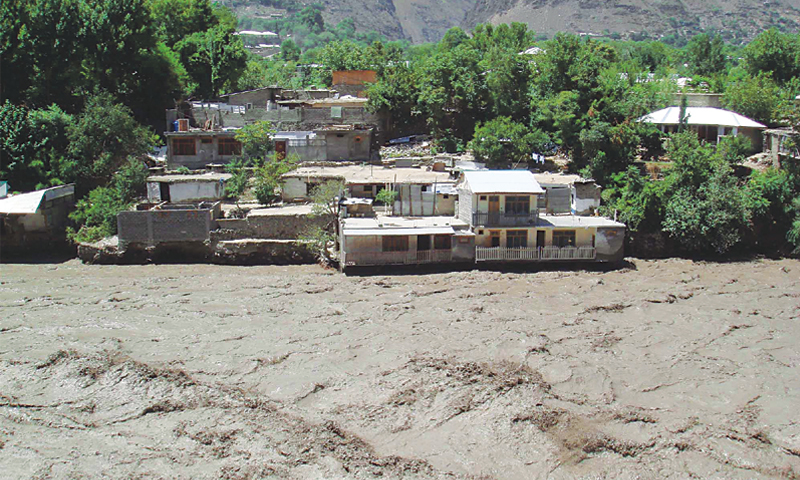

Ferocious floods have once again devastated Pakistan, leaving behind a trail of destruction in the Chitral valley. Villages upon villages have been washed away, creating untold difficulties for the survivors. In the plains, communication can be restored relatively easier using boats. Chitral is a different story.
Landslides and avalanches carrying with them tonnes of mud, huge boulders and rocks have shot through the villages, homes and hearths of poor peasants; burying them and their dear ones, their belongings, their cattle and the crops. The survivors are without tools to dig for those buried under the debris.
The injured are in pain, dying or maimed without any medical care. There is no food or drinking water and no milk for babies. There is little fodder for the surviving cattle.
Recent floods have once again highlighted the devastating effects that climate change, coupled with human activity, have had in Chitral. Understanding the problem is, however, only the first step towards finding a solution
Nights in Chitral can be very cold. There is no electricity, no telephones, no clothing, no beddings no heating and above all no shelters...not even tents. And the merciless rains go on. People are living constantly under the terrifying threat of more landslides.
Roads and bridges have been washed away. Weather permitting, military helicopters have been flying relief sorties. Those who can have moved sometimes miles uphill on foot to safer abodes carrying the injured, children and whatever meagre belongings they could.
For rebuilding homes, roads, bridges, protective bunds and walls, we have only four months before the winter rains start.
The mountains in Northern Areas and Chitral are prone to land sliding. For centuries, forest trees have protected the 45 degree slopes of these mountains against erosion and landslides. But these trees are gone now, felled by the timber mafia.
The people of Chitral have been protesting against the entrenched timber mafia that is busy denuding their forests; not only robbing the nation of priceless resources, but actually threatening lives and the sustainability of the valleys.
“Illegal deforestation and its impact can be seen in videos prepared by local people. The flooded rapids were entirely covered by felled trees, to the extent that rushing water was not visible. Maureen Lines, an ardent environmentalist, who heads the Kalash Environmental Protection Society, has been thrown out of Chitral by such powerful interest groups, several times, for her efforts to protect Chitral’s forests. Her pleas for massive forestation and an effective ban on the ubiquitous timber mafia have fallen on deaf ears,” says Col Ejaz Nazim, Convener and President, Shajardost Tehreek, Lahore.
“The damage owing to deforestation for decades and inadequate reforestation has already taken its toll, and it’s too late for implementation. Massive reforestation today will be able to hold the slopes only when the trees are 45 or 50 years old. Still, it is better late than never,” says Nazim.
“The newly planted trees need stable slopes, and there are methods to stabilise them. The Japanese train their people in these techniques, and we can make use of their expertise. Working on such a colossal scale, very large amount of funds and resources are required. But above all, what is most required is the will to undertake this project and according to it the right priority over other show piece projects,” he elaborated.
Recent floods in Chitral have brought to light the fact that ecological factors and development go hand in hand
The much decorated NGOs working in KP and Chitral have the capacity to include conservation, forestation and advocacy, besides disaster management in their mandate; and above all they have huge funds at their disposal. But they lack vision and political will. The Lowari tunnel, despite its economic and social benefit, is feared to entail ecological and conservation challenges. In the geographically small Chitral and Kalash valleys both the development and government sectors appear ill-prepared.
Several livelihood and micro hydel projects have been washed away by the current disaster. Is it not time for change of mind by the “development sector” concerned with livelihood outcomes alone?
The ecological factor has been perilously ignored, when climate change is considered a game changer globally, particularly in the vulnerable Himalayas, Karakorum and Hindukush mountain ranges. It is time the debate on environment takes centre stage.
A vintage quote is relevant to the ongoing “development versus conservation” debate. “In nature there are neither rewards nor punishments; there are only consequences.” — Robert G. Ingersoll.
The writer is a founding member of Sarhad Conservation Network, KP; adilzareef@yahoo.com
Published in Dawn, Sunday Magazine, August 23rd, 2015
On a mobile phone? Get the Dawn Mobile App: Apple Store | Google Play




























