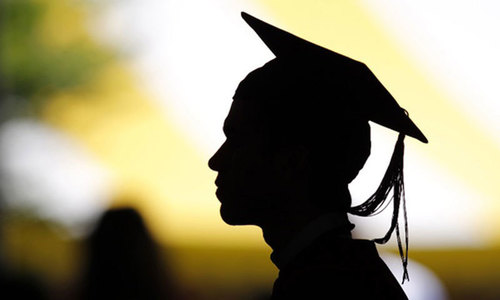
Higher education has seen a remarkable progress in Pakistan recently with an increasing number of students enrolling for Masters’ and Doctoral degrees.
However, research culture in the country is still far from being inspiring and is adversely influenced by a lack of third party supervision and a dearth of quality academic professionals. This has continually affected the calibre of Pakistani students.
Research training usually begins when a student pursues his M.Phil or MS degree. Apart from course work, Pakistani institutions offer no help to enhance a students’ understanding of research and dissertation writing.
A students’ lack of critical thinking and writing skills only add to the problem.
Taking ‘shortcuts’
Getting a PhD is not as easy as it may sound. More often than not, students hire professional services to write dissertations for them, paying large sums of money. They do not hesitate in spending this amount for the enticing long-term benefit – a degree and a big promotion.
Dr. *Mansoor, a PhD and an academic, narrated his situation;
Every kind of student gets a grind in PhD. And those with no understanding of research are like rolling stones. I personally know people who have paid two to four hundred thousand rupees to get their research done. Competent students also struggle, albeit in a different way.
The yes-man dilemma
Currently, there are also no formal checks on the relationship between a supervisor and supervisee. This gives immense authority to the supervisor who is not answerable to anyone.
Another PhD student, *Naeem, told me;
My supervisor avoided me, but always had time for my batch mate who lavished him with gifts and flattery. I believed in my competence and did not want to be his ‘yes-man’. The result; my batch mate has finished his degree, while mine is in the process even after 8 years.
Favours for a degree
Completing a PhD degree within the time frame is another major concern because the system does not enforce a proper timetable. In fact, it takes double the time in Pakistan compared to other countries that follow a timetable. The final submission takes place only when the supervisor is ‘satisfied’ with the candidate, otherwise the student has to keep waiting.
*Tabish who successfully completed his dissertation recently, told me;
My supervisor coerced me into tutoring his children; overseeing the construction of his house and so on. He brazenly declared that if I don’t do him these ‘favours’, he will not approve my synopsis. So I did what was required. Today, I have my degree.
Another common practice in the academia is to make students publish papers for supervisors. Staffers are required to publish a certain number of research papers in order to get promoted, and that number is often met with the ‘unconsented’ help of their students.
Dr. *Masood, who became a victim of such exploitation, revealed:
One day my supervisor called me and inquired about my research papers. I told him that I was working on them. He instructed me to include his name and also pay the charges for its publication, to which I agreed. As I was about to walk out of his office, he said, ‘Don’t forget that tomorrow is your final PhD seminar. I’m the one in-charge of signing off your degree’. His message was very clear...
Women have to pay an even higher price – sexual favours. The situation is appalling within public sector institutes.
A PhD student *Samreen told me;
Soon after my enrolment in PhD, my supervisor started asking me to go out with him for dinners. He said that all my seminars will be successful if I did what he wanted. I tried my best to have a professional relationship with him but failed stop his advances. Eventually, I had to quit my PhD. I had no other choice.
In 2014, a case reported at LUMS accused a former Law faculty member of sexually harassing his female student. He was immediately dismissed after the student filed a complaint with the federal ombudsman.
Obtaining a PhD is a long and strenuous process in which a person is more likely to experience anxiety and depression. In such a situation, a conducive learning environment and help from the institution is crucial for a student to complete this process successfully, if not cheerfully.
Also read: Pakistani teachers, check your egos at the door
The above mentioned accounts of PhD students underscore the moral corruption within the system. As a result, our students lack competence on library research skills, referencing, finding resources and drafting a dissertation. Such students often go on to become part of the academia and tend to reproduce what they have suffered.
Check and balance
The current situation requires a thorough assessment and implementation of improved rules; a non-partisan body must monitor the progress on research degrees in Pakistan. The Higher Education Commission should be in direct contact with PhD students and form a thesis advisory committee which would meet the supervisor and supervisee twice a year to check their progress and resolve any issues.
Also read: The HEC should never rank Pakistan's universities
In this regard, M.Phil and PhD timetables for completion will also be very helpful. It will enable both the supervisor and students to set deadlines. The institution and the HEC should keep record of the timetable and closely monitor whether or not the student is meeting his targets.
Last but not the least, research students should empower themselves with language and research skills. Help from the federal ombudsman must be sought and a complaint against any mal-administration must be lodged.
By doing so, students can not only save themselves from degradation and exploitation, but can also counter those who oppress them.
Disclaimer: Names with an asterisk have been changed to protect identities.