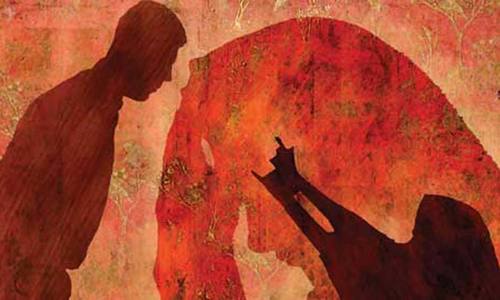
Prime Minister Nawaz Sharif recently watched A Girl in the River: The Price of Forgiveness, Sharmeen Obaid Chinoy’s Oscar-nominated documentary about ‘honour’ killings. In a statement following the screening, he told Ms Chinoy and his audience that there is no ‘honour’ in murder.
In the days since it has been announced that the government will move to plug holes in laws that currently allow killers (often family members) to go unpunished. Ms Chinoy has expressed the hope that her film would help put an end to honour killings in Pakistan.
Read: No honour in honour killing: PM
It would be wonderful if her wish came true. The reasons it will not are the ones that the government needs to address if it truly wishes to tackle the problem.
The root of the problem is that women (and men) are considered social capital in a family.
Before reasons, however, consider context. I pulled up two sets of statistics compiled by the Human Rights Commission of Pakistan (HRCP). The first covers the period spanning Feb 1, 2004, to Feb 1, 2006. During this time, there were 988 incidents of honour killings in Pakistan. Nearly, but not exactly half, did not even have FIRs registered for the crime. Firearms were the weapon of choice for doing away with the victims, followed by blunt force injury with a heavy weapon.
Fast-forward a decade: another set of statistics I pulled from the HRCP database was from between February 2014 to February 2016. The number of honour killings in this period was 1,276, nearly 400 did not have FIRs registered, and most of the victims were killed by guns.
The decade in the middle has not been one without legislative initiatives or civil society campaigns to end honour killings. I chose the period immediately following 2004 because that marked the passage of a bill against honour crimes. As political machinations go, the bill that was actually passed was a diluted version of the one first introduced by senator Sherry Rehman. There was much clapping and clamour then too.
The whole thing repeated itself in March of last year with the passage through the Senate of the Anti-Honour Killings Laws (Criminal Laws Amendment) Bill, 2014. Meanwhile, international human rights organisations have devoted budgets and campaigns to ending honour killings in Pakistan. As the numbers show in both cases, honour killings (to the extent they are even reported) have continued and even increased.
Here is why. First, legislative initiatives have focused on the legal dimensions of the issue, the latest a much needed amendment to the qisas and diyat laws that would prevent the pardoning of honour killers. This is a great idea.
At the same time, like legislative initiatives of the past, it has no teeth at all against the root of the problem: that women (and men) are considered social capital in a family, marrying them a form of adding sociological assets, creating relationships that families, increasingly torn by migration and demographic change, require.
When a woman rebels against this mechanism, not only does the family lose the possibility of capital accrued from arranging her marriage, her decision jeopardises the futures of remaining brothers and sisters, their possibilities of making good matches that sustain them in a web of relationships where individual choice defeats collective security.
In a cultural and sociological system where the family and tribe are still the only and often unitary form of social insurance against catastrophe, the death of a breadwinner, illness and job losses, collective control over the individual is the glue that holds everything together.
Honour killers kill because they think they are preserving the system, saving the sisters who did not run away. To overcome honour killings, a robust state must take the place of the family in providing basic guarantees of security against debilitating losses; until it does so, the cruel elimination of those who wish to make their own choices will continue.
The second reason for failure lies in the broken mechanisms of international advocacy, particularly as they exist in countries like Pakistan, which have faced the brunt of international aggression. Simply put, since “saving brown women” became the reason to go to war, stories of hapless victims of honour killings in countries like Afghanistan, Pakistan, Iraq and Syria have served to fuel a moral reason as to why such imperial overtures are justified. Some brown women, those at risk of honour killings, are to be saved; others who happen to be near target zones for drones do not.
The hypocrisy of this is not lost on local populations but it manifests in a particularly grotesque way in the towns and villages of Pakistan that have borne direct hits from American aggression; maintaining honour, which translates roughly to controlling women, has become a nationalistic goal, a stand for local sovereignty.
Women are paying with their lives; simply telling their stories has not saved them and will not save them. This last point is important, for it represents a very troubling moral bifurcation in the aid and advocacy economy via which campaigns against honour killings are funded and the communities in which moral change must take place.
The campaigns are providing jobs and causes and in some cases, international acclaim for a few; but that will never bridge the vast chasm between top-down advocacy and urgently needed grass-roots change.
The words of the prime minister are heartening. Like most women, I would rather have a leader willing and sincere in recognising the horror of honour crimes than one who capitulates as so many others have done.
A Pakistani woman honoured at the Oscars is also a good thing, an inspiring individual victory and a hopeful honouring, even if it is one that cannot stop future dis-honourings of less lucky Pakistani women. For that, a deeper effort is required, a local and grass-roots conversation directed at those for whom family, honour and survival are intertwined, the murderous killing of the rebel justified because it pretends to be saving all the rest.
The writer is an attorney teaching constitutional law and political philosophy.
Published in Dawn, February 24th, 2016