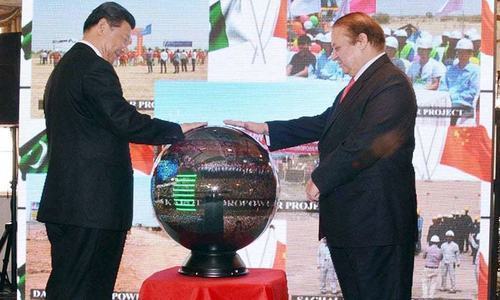

A game changer that will make Pakistan an Asian Tiger is how the PML-N sells the CPEC. None of the Tigers rose simply by building corridors with economic giants. So, one must view such claims cautiously. Still, this is the biggest economic opportunity to come Pakistan’s way in decades.
That this is happening under an elected regime and autocracies could never conjure similar feats underlines democracy’s long-term potential. The PML-N deserves kudos for creating this opportunity. But the critical question now is whether it can transform opportunities into reality. One feels compelled to raise some concerns, at the risk of being branded unpatriotic even though the aim is patriotic in flagging possible pitfalls affecting attainment.
Firstly, project details reveal that around $11 billion (25pc) of the money is for port, road and railway linkages between Pakistan and China. But the vast majority of the money — nearly 75pc — is for power plants which will not directly contribute to the economic corridor unless they feed industries whose outputs travel on the corridor.
However, CPEC plans only contain vague references to establishing industrial parks. Thus, there is not one integrated CPEC but actually two unconnected CPECs presently: the China Pakistan Economic Corridor (25pc) and ‘China Pakistan Electricity Cooperation’ (75pc). Unless PML-N integrates the two, the chances of Pakistan becoming an Asian Cub, nary a Tiger, will be remote, though the two unconnected CPECs will still benefit it individually.
There are actually two unconnected CPECs.
The ‘China Pakistan Electricity Cooperation’ contains 24 projects, as shown on the Planning Commission’s website, to be built by Chinese companies’ FDI with Pakistan obligated to buy their output at unknown rates. Thus, the first challenge will be avoiding the exorbitant rates Pakistan faced earlier with IPPs and weaker states often face with China. Given the serious logistical and technical problems with recent power plant construction in Pakistan, ensuring successful execution will be another major challenge.
There are regional issues too. Of the total $35bn investment in power projects, nearly $10bn is for Sindh, $7bn for Punjab, $8.5bn for Balochistan, $2.5bn for Azad Kashmir, $1.8bn for KP, $4.5bn for projects involving Punjab and another province and apparently zilch for GB, which ironically provides Pakistan actual access to China on the economic corridor.
Thus, Balochistan is the only backward region with a high share. However, given past history, it will require special efforts to ensure that the employment and electricity generated by projects there benefit its residents equitably.
Finally, environmental issues are also salient as the biggest chunk of the projects involves coal. Even if all these challenges are overcome, Pakistan will only regain the pre-2005 situation of adequate electricity when its economy was growing but without being transformed into a Tiger.
The more strategic element is the actual China Pakistan Economic Corridor which, if handled properly, provides the potential to link Pakistan’s economy with China and beyond and result in its structural upgrading. This component covers investment of around $11bn, including $10bn loans by China to Pakistan at highly concessional 1.6pc rate for roads and railway work, and around $1bn grant for Gwadar port, airport and other projects.

Even here, nearly $3.5bn is for the upgrading of the Karachi-Peshawar railway tracks which cannot be immediately considered part of the economic corridor until it gets linked to China, which is only planned by 2030. Thus, only around $7bn or around 15pc of the $46bn will actually go immediately towards building the real CPEC!
Even here, besides the Gwadar work, the commission website only mentions the Raikot-Islamabad and Multan-Sukkur motorways but not the western route or even a link from Sukkur to Gwadar. Even if a complete Gwadar-Khunjerab motorway gets built, it will mainly yield transit fees on Chinese traffic like on Nato convoys and income for the hotels, workshops and brothels which invariably emerge on major trucking routes. It is yet unknown how much transit fees Pakistan will charge and earn annually. Nor is there any study about the likely impact of motorways construction on broader local economies along their routes.
Accruing higher returns from CPEC will require strategic thinking and projects to link Pakistan’s industrial output with China’s markets as it transits to a consumption-led economy facing labour shortages. The commission has the economic, social and political experts to develop ideas, feasibility plans and technical reports for such strategic projects which also ensure equity and sustainability.
Unfortunately, its website till now reflects little such use of these capacities, containing only a skeletal list of projects and a few maps. Until such strategic thinking emerges, even Nawaz Sharif’s less ambitious plans to link Kashgar with Gwadar will remain dreams like Iqbal’s desires to link Kashgar with the Nile’s banks.
The writer is a political and development economist.
Published in Dawn, March 1st, 2016