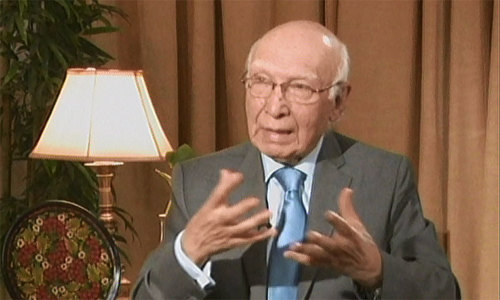
ISLAMABAD: Former permanent representative at the United Nations in Geneva Zamir Akram said on Tuesday that Pakistan was only opposed to “exclusive membership” of the Nuclear Suppliers Group (NSG) for India.
He was speaking at a roundtable discussion organised by the Strategic Vision Institute (SVI), a think tank, on the implications of the upcoming plenary session of the NSG, which is expected to deliberate on membership for non-NPT states, including Pakistan and India. The NSG plenary session is being held on June 23-24 in Seoul.
Ambassador Akram’s comments follow remarks by Indian Foreign Minister Sushma Swaraj that India does not object to any country, including Pakistan, joining the NSG on merit.
“Pakistan supports the evolution of criteria that can be applied across the board,” Amb Akram said.
The Indian and Pakistani comments suggest that their respective campaigns for NSG entry had boiled down to ‘merit’ versus ‘criteria’.
India seeks a merit-based approach, which is primarily based on geopolitics and geo-economics. Pakistan, meanwhile, has been insisting on uniform and transparent criteria for non-NPT states. Both Pakistan and India have not signed NPT.
The Pakistani position is consistent with the Chinese stance on the matter. China is the leading challenger to the West-supported bid to get India into the 48-member nuclear trade cartel. According to the Chinese foreign ministry spokesperson Hua Chunying, “China maintains that the NSG fully discuss the accession of non-NPT countries and make decisions based on consultation in a way acceptable to all”.
Some other countries, including a few of those which had earlier pledged support for Indian case, also voiced reservations over Indian candidature at a meeting of the group in Vienna on June 9.
Speaking at the roundtable, Amb Akram warned about the likely implications of a scenario in which India alone was admitted into the NSG, including dimming of future prospects for Pakistan’s entry into the club and likely growth in Indian nuclear arsenal.
SVI President Dr Zafar Iqbal Cheema said that India’s alone entry into the NSG would put back Pakistani efforts for developing its infrastructure and industry by decades. Therefore, he maintained, such an eventuality would have serious consequences for national security and economic and industrial development.
He observed that India was one of the worst proliferators, but Pakistan could not capitalise on it. He recalled that India once had scornful disdain for non-proliferation regimes, which has now been conveniently forgotten by the world.
Published in Dawn, June 22th, 2016