Outrage ensues after Indian politicians blame alleged groping on women’s ‘Western’ clothes


The allegations spread like so many of the others had.
In an article headlined Bengaluru’s Night of Shame, Bangalore Mirror reported on a New Year’s Eve party in the southern Indian city that had devolved into an unruly mob in which female partygoers were allegedly molested en masse.
“All hell broke loose close to midnight as hooligans in the garb of revellers started pawing, molesting and passing lewd remarks on women on the streets, forcing some of them to literally take off their stilettos and run for help,” the newspaper reported.
Accompanying the story were pictures of some women looking distressed, of others fleeing the chaos and, later, of baton-wielding police officers facing off against crowds of angry men.
Although the paper recorded eyewitness accounts, it said Bangalore police had not received any harassment reports that night.
Still, the incident ignited outrage on social media — first among those who said they were “aghast” at what had reportedly taken place, under the hashtag #MassMolestation.
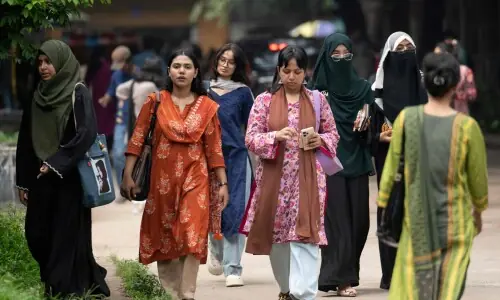
In the wake of those reports, even more furore erupted after some politicians spoke out about the Bangalore party, suggesting that the fault of any harassment lay with the women and in what they chose to wear.
Karnataka Home Minister G. Parameshwara blamed the incident on women’s wearing “Western” clothing, Al Jazeera reported.
“They try to copy Westerners not only in mindset, but even the dressing,” Parameshwara said, according to the news site. “Some girls are harassed, these kind of things do happen.”
The sentiment prompted a rebuke by Indian Home Affairs Minister Kiren Rijiju, who called Parameshwara’s comments “irresponsible” on Twitter.
“We can’t allow the shameful act of #MassMolestation [to] go unpunished,” Rijiju said in a follow-up tweet. “Bangaluru is a vibrant city & women safety is must in a civilised society.”
Abu Azmi, the head of the Maharashtra state branch of the Samajwadi Party, went a step further than Parameshwara, implying that women’s clothing choices could invite sexual assault in the same way other reactions occur in nature.
“In this modern era, the more naked a woman is, the more fashionable people say she is,” Azmi told ANI News. “If my sister or daughter goes out to celebrate New Year’s Eve and her brother or husband isn’t with her, then that’s not fine.”
Upon further questioning, Azmi continued.
“If there’s petrol and a fire comes along, then the fire will light,” he told the news station. “If sugar has fallen, then ants will surely come. People will get angry with me for this, but it’s fine because it is true.”
People did, in fact, become angry with Azmi over his remarks.
Indian comedian Sonam Mahajan tweeted a picture of Azmi’s daughter-in-law, Bollywood actress Ayesha Takia, wearing a sports bra and cut-off shorts. “Are you trying to say that she deserves a #MassMolestation?” Mahajan wrote in the tweet, which was widely shared.
Still, a counter hashtag, #NotAllMen, trended in India in the days after the New Year’s Eve party, as some people sought to say it was unfair to blame men if they were not involved, the BBC reported.
That, too, was met with a backlash, and soon it appeared that rebuttals to #NotAllMen outnumbered whatever original tweets may have shown up under the hashtag.
“#NotAllMen because in an incident involving the molestation of women, random men were the real victims,” comedian Sorabh Pant responded sarcastically.
Such vocal backlash against an alleged sexual assault has become more frequent in India ever since a 23-year-old medical student died in 2012 after being brutally gang-raped on a bus in New Delhi. That case seemed to turn a spotlight on the country and the circumstances that allowed a culture of sexual violence to flourish unchecked.
Protests and violence followed the 2012 case. As The Washington Post’s Olga Khazan and Rama Lakshmi reported then, citizens were railing against not only the woman’s assault and death, but also the deep-rooted factors that had allowed the rape to happen: there were too few female police officers and a troubling tendency to blame and stigmatise victims of sexual violence for any crimes. Societal pressures sometimes forced victims of rape to “make peace” with their attackers; those cases that did make it to court often stalled in a backlogged judicial system.
Two years after the infamous case, a Hindustan Times survey found that more than 90 per cent of women between the ages of 13 and 55 thought New Delhi had not become any safer, despite the government’s passing an anti-rape law and making other promises to make public buses and streets safer for women.
On Tuesday, Rega Jha, the editor in chief of BuzzFeed India, called the reflexive blaming of women a “now-too-familiar twist”, in a widely shared essay titled Indian Parents Aren’t Raising Their Sons Right, And It’s Endangering India’s Women.
“When women on Twitter raged against the male mindsets that make incidents like the one that took place in Bangalore possible, hordes of Indian men took offense,” Jha wrote. “They insisted that generalisations are unfair because ‘not all men’ disrespect women. #NotAllMen has trended in India all day. That’s how jarring it is for Indian men to have to take responsibility for attacks on women.”
Jha lamented the seeming lack of progress that had been made on this front and blamed the different approaches parents take when they raise sons vs daughters.
“Bangalore reminded us — as other cities, other incidents, other headlines have reminded us month after month — that, for an Indian woman, this isn’t a world worth trusting,” she wrote. “It could be, if Indian boys were raised with even half as much deliberation as daughters in India are subject to. Half as much instruction, restriction, caution. But the freedoms in an Indian boy’s upbringing are absolute. Since sexual assault isn’t a daily threat to boys, it isn’t even brought up.”
—By arrangement with The Washington Post
Published in Dawn, January 5th, 2017