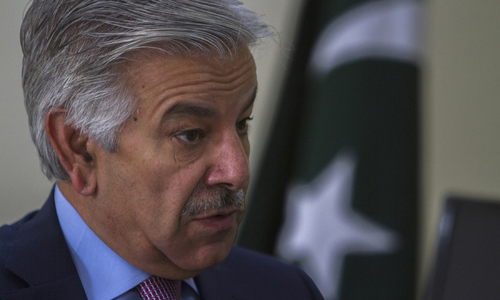
Defence Minister Khawaja Muhammad Asif on Friday confirmed the recent development that former army chief General (retd) Raheel Sharif was made the chief of 39-nation Islamic military coalition formed to combat terrorism.
Speaking during a talk show at Geo TV, Asif admitted that an agreement in this regard was finalised few days back; however, the defence minister said he didn’t have much information at the moment about the details of the said agreement.
Asif said that the decision to appoint Gen (retd) Raheel, who retired in November 2016, was taken after taking the incumbent government into confidence.
"No, definitely our government's consent must have been part of this," he replied when asked if the decision was taken in Riyadh or Islamabad.
When asked whether General Headquarters (GHQ) must also have okayed the decision, Asif replied, "There is a set procedure for clearance," adding that such a move "definitely" cannot take place without following this procedure.
He was, however, unaware of the exact details.
“As you are aware that this thing was in the pipeline for quite some time and the prime minister was also part of the deliberations,” Asif said.
He was of the opinion that formation of such an alliance is a good step, as the “Muslim Ummah is in a spot of bother right now and needs unity among its ranks”.
The headquarters of the Saudi-led coalition would be based in Riyadh.
Also read: Pakistan will not participate in conflict that divides Muslim Ummah: Khawaja Asif
Pakistan had initially found itself in the crosshairs of Middle Eastern politics as Saudi Arabia named it as part of its newly formed military alliance of Muslim countries meant to combat terrorism, without first getting its consent.
However, after initial ambiguity, the government had confirmed its participation in the alliance, but had said that the scope of its participation would be defined after Riyadh shared the details of the coalition it was assembling.
The coalition was envisaged to serve as a platform for security cooperation, including provision of training, equipment and troops, and involvement of religious scholars for dealing with extremism.
The Saudi government had surprised many countries by announcing that it had forged a coalition for coordinating and supporting military operations against terrorism in Iraq, Syria, Libya, Egypt and Afghanistan.
Iran, Saudi Arabia's archrival for influence in the Arab world, was absent from the states named as participants, as proxy conflicts between the two regional powers rage from Syria to Yemen.