THE internet revolution that came to Pakistan in 1996 has, 20 years on, had massive impact on all walks of life — academic, cultural, social, and economic. The rising popularity of the micro-blogging site Twitter has irrevocably changed the traditional ways in which politicians and government representatives communicate with their constituents. But is all this tweeting to the benefit or the detriment of our nation and its governance?
Twitter has been in existence since 2006; users can sign up for accounts in their real names or anonymously, and post short messages of 140 characters. In 10 short years, it has become the place for much political movement, first grass-roots actions like communication and organisation, as well as information dissemination. The Atlantic states: “Twitter has grown into a force that has bolstered grass-roots conversations, disrupted the top-down nature of political leadership and thought, and has given voice to groups long hidden on the political periphery.”
In the United States, President Barack Obama seized on the opportunity to use Twitter. For the first time, an American president was speaking directly to other Twitter users to send out short, punchy messages about his leadership vision, and his reactions to domestic and international events. Meanwhile, political parties and movements large and small began to harness the power of Twitter and its ability to amplify messages, as well as its challenge to mainstream media by giving everyone a voice and access to the public.
Pakistanis hope their leaders will favour them with a retweet.
World leaders and governments took some time to catch up to the American initiative, but today we see every nation’s leader has a Twitter account, including Sheikh Mohammed of Dubai (who tweets in Arabic and English), India’s Prime Minister Narendra Modi, Queen Rania of Jordan, etc as well as the young members of the British royal family.
Twitter has become a necessary part of official government workings in many countries, with diplomats at home and abroad equipped with an iPad and an official Twitter account. The quick and powerful medium with direct connections to millions of people, can, if used right, increase individual or collective cachet, cause a politician’s popularity to skyrocket, and make government more effective in listening to the voice of the people.
In Pakistan, Twitter was slow to catch on at first, and still remains a tool of the somewhat elite and educated, the first people to gain access to the internet. But with the boom in cheap smartphones (13.5 million subscriptions to mobile broadband in 2015) and the advent of 3G in the country, 17.2m Facebook accounts and 280m connections to Twitter a day, Pakistani officials and political parties knew they had to join the trend or risk irrelevance.
As the site ProPakistani writes, the last three or so years has seen a proliferation of government officials and agencies take to Twitter and Facebook in order to announce their activities, solicit public feedback, and deliver pro-social messages to the Pakistani public. The Pakistan Army’s ISPR uses Twitter to make announcements about security situations and progress in national emergencies. Diplomats and bureaucrats are not up to speed yet with Twitter or Facebook, and while most Pakistani embassies around the world have official Twitter accounts, they aren’t very active.
On the other hand, Pakistani politicians have taken to Twitter like gasoline on a fire. Some of the most popular Twitter accounts belong to leaders like Imran Khan, Bilawal Bhutto-Zardari and Maryam Nawaz Sharif, who spend much of their time tweeting allegations at each other. Mavericks like Sheikh Rasheed and stalwarts like Dr Arif Alvi lend their personalities to their Twitter accounts, using Urdu and English to raise chuckles and deliver sober accountability respectively. It’s a lively arena with ordinary Pakistanis forming breathless fan clubs and fighting with each other in the hopes that their favourite politician-cum-celebrity will favour them with a ‘retweet’ or a ‘like’.
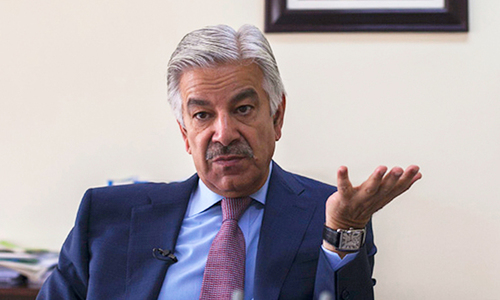
But our politicians and government representatives must bear in mind the weight of their office and their responsibility to the people when composing a tweet. Take the example of Defence Minister Khawaja Asif, who on Dec 23, 2016, reminded Israel of Pakistan’s nuclear ability in a tweet. He reacted to fake news that suggested Pakistan would send ground troops to Syria, with Israel purportedly threatening to retaliate with nuclear weapons if this happened. This tweet made it to the pages of international newspapers and turned Pakistan into a laughing stock.
The inventor of Twitter probably didn’t envision a nuclear incident resulting from an ill-thought-out tweet, but if anyone could make such a Stanley Kubrick-esque scenario a reality, it would be a Pakistani politician. With great Twitter power comes great Twitter responsibility; our leaders need to restrain themselves from abusing it to the detriment of the people they claim to serve.
The writer is an author.
Twitter: @binashah
Published in Dawn, January 9th, 2017