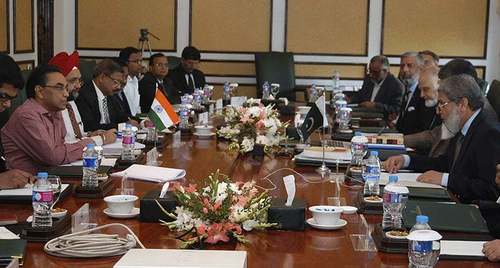
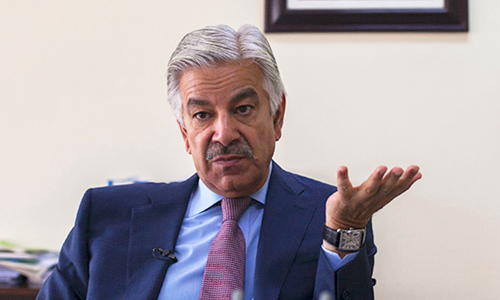
WASHINGTON: Pakistan and India displayed goodwill and cooperation in the latest round of talks on a water dispute and have agreed to meet again next month, the World Bank said.
The World Bank hosted the two-day talks, which concluded on Tuesday, and the next round of talks will also be held at the bank’s headquarters in Washington.
“The secretary-level discussions between India and Pakistan on the technical issues of the Indus Waters Treaty took place this week in a spirit of goodwill and cooperation,” said a brief statement issued after the talks. “The parties have agreed to continue discussions and reconvene in September in Washington,” the bank added.
The bank also released a brief description of the dispute and of its efforts to resolve it, along with a short background of the Indus Waters Treaty (IWT), signed in 1960.
India and Pakistan disagree about the construction of the Kishenganga (330MW) and Ratle (850MW) hydroelectric power plants being built by India. The bank clarified that it was not financing the disputed projects.
India and Pakistan disagree over whether the technical design features of the two hydroelectric plants contravene the treaty. The plants are being built on a tributary of the Jhelum and the Chenab rivers.
The bank notes that the treaty “designates these two rivers as well as the Indus as the western rivers to which Pakistan has unrestricted use”.
But the bank also points out that India is permitted to construct hydroelectric power facilities on these rivers subject to constraints specified in annexure to the treaty.
Pakistan has asked the World Bank to facilitate the setting up of a court of arbitration to look into its concerns about the designs of the two hydroelectric power projects. India asked for the appointment of a neutral expert for the same purpose. The requests followed a series of bilateral talks that failed to resolve the dispute.
The bank says that it sought to fulfil its procedural obligations with respect to both the court of arbitration and the neutral expert but the treaty does not empower the World Bank to choose whether one procedure should take precedence over the other. The treaty vests the determination of jurisdictional competence on each of the two mechanisms. “At the same time, the World Bank actively encouraged both countries to agree amicably on a mechanism to address the issues,” the statement said.
On Dec 12, 2016, World Bank Group President Jim Yong Kim announced that the bank would pause before taking further steps in each of the two processes requested by the parties.
It said that since December 2016, the bank had worked towards an amicable resolution of the matter and to safeguard the treaty. Mr Kim spoke several times with the finance ministers of both countries. World Bank Chief Executive Officer Kristalina Georgieva travelled to both countries for high-level meetings. The World Bank Vice President for the South Asia Region, Annette Dixon, visited both countries twice. Mr Kim’s adviser, Ian Solomon, made multiple visits to the region.
The bank explained that locally-based World Bank teams had convened dozens of meetings with different stakeholders. “A variety of proposals have been discussed.”
Published in Dawn, August 3rd, 2017