United States (US) Ambassador to Pakistan David Hale assured National Security Adviser (NSA) Lt Gen (Retd) Nasser Khan Janjua on Thursday that President Donald Trump did not blame Pakistan for the failure of the War on Terror in Afghanistan.
As Hale and Janjua met today in Islamabad to discuss the Trump administration's new strategy on Afghanistan and South Asia, the US envoy claimed the perceived misconceptions it arose due to the press taking the policy apart piece by piece instead of interpreting it as a whole.
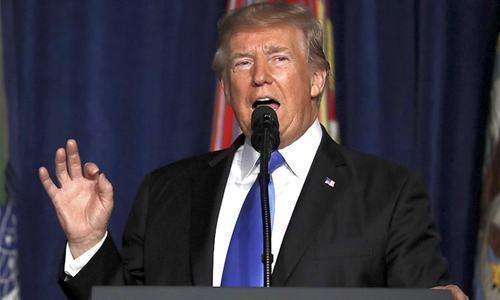
Trump, in his Aug 21 diatribe, denounced Pakistan for allegedly allowing terrorists to maintain safe havens inside its territory.
He also seemed to want India to take on a bigger role in Afghanistan, stoking fears in Islamabad that India would use this opportunity for stirring trouble in the bordering areas of Pakistan.
Read more: Trump backs off Afghan withdrawal, lambastes Pakistan over terrorist 'safe havens'
According to a press release issued by NSA Janjua's spokesperson, Hale said it was wrong to assume that the policy recommended a purely military solution, or that engagement with Pakistan had been ruled out. Military strategy, he said, was just one piece of the policy which espoused a political solution.
NSA Janjua told the US envoy that Pakistan was taking its time to examine the US policy and considering its options. He added that Islamabad would like to receive further details from the US.
"This notwithstanding, President Trump’s address at Fort Myers was disappointing and had deeply hurt the feelings of the government and the people of Pakistan," the NSA said, according to the handout.
He told Hale that Pakistan had been "wrongly blamed, threatened and negatively projected to the world, which was unacceptable".
"Our nuclear weapons were wrongly linked to terrorism, which was totally uncalled for. The new policy has created uncertainties and further added to the regional fragility and imbalance," he added, saying this was why the policy drew such a sharp response in Pakistan.
India's role in Afghanistan
Ambassador Hale told NSA Janjua that the US government is "aware of the feelings in Pakistan" regarding the role envisaged for India in the new strategy.
He said the Trump administration was "ready to play its role in reducing tensions between the two neighbours", the NSA spokesperson said .
He further clarified that India’s role was envisaged for economic development in Afghanistan only.
NSA Janjua, however, said that the creation of competitiveness within a campaign and alliance is "counter-productive" and "we should not go that way".
Afghan strategy
Hale told Janjua the policy supports the role of regional countries in a peaceful settlement in Afghanistan, adding that Pakistan had an important role to play.
The US was "thinking of reviving and accelerating the Quadrilateral Coordination Group and the Six-Plus-One process on Afghanistan", Hale said.
He clarified that additional US troops in Afghanistan would be deployed as trainers of the Afghan security forces. Hale claimed that "enhanced authority for decision-making given to field commanders meant quick action against all terrorist groups, including the Tehreek-i-Taliban Pakistan".
Washington had also called on Kabul to "realign itself for playing its full role in controlling the insurgency and winning over the hearts and minds of the people, while improving its governance", he said.
NSA Janjua stressed the need to work together to "close" the conflict in Afghanistan instead of "winning" it, which Ambassador Hale agreed with.
Janjua, pointed out the risks and dangers of a purely military strategy, the handout read. He instead suggested the establishment of a parallel political authority Afghanistan, fully empowered by the US, that would work in tandem to military commanders to help find a peaceful, political solution to the conflict, and bring the perpetual conflict in Afghanistan to a quick closure that was in the best interest of all parties.
He also observed that any kinetic action would further vitiate the situation and should be avoided, which Hale agreed with, saying that the situation needs to be normalised.
The NSA and the ambassador both reiterated the agreement to work very closely to find a solution seeking closure of the Afghan conflict.