

Khwaja Khizr: The saint who 'saved' Rohri, Sukkur and Lansdowne Bridge during the 1965 War


On a warm morning this March, I was passing under the heavy iron vaults (arches) of the Lansdowne Bridge, in a small jeep over the Indus River in Rohri, Sindh. The spring sun had turned the water into molten gold; some buffaloes were idly bathing in it, their black skin gleaming in the sunlight.
I could see the cities of Rohri and Sukkur sprawling on both sides of the river. I was lost in thought as we were speeding by Rohri and its beautiful pre-Partition houses and their enigmatic wooden balconies, when I heard our driver ask me “Adi, do you know how this bridge and cities were saved during the 1965 War?”
“No, I don’t,” I replied, rather ashamed of my lack of general knowledge.
“Well, it was he who did it,” the driver said pointing towards a far off dilapidated structure inside the river.
“Who?” I tried hard, but couldn’t see anyone nearby.
“Khwaja Khizr saved it from destruction, the saint you are going to visit,” he replied reverently.
When I questioned further, he narrated a story popular in the twin cities of Sukkur and Rohri. During the Indo-Pak War of 1965, when Indian planes came to bombard this strategically important bridge, people noticed that bombs wouldn’t explode and harm their targets.
Some claim to have seen a green-robed man standing over the bridge, disarming the bombs, and that is how the bridge, Rohri and Sukkur were saved from destruction.

Despite it being a myth, the story nonetheless shows the devotion accorded to Khwaja Khizr by the people of this area, where River Indus flows and is also worshipped.
In Sindh, like everything else, he is transformed into a heterodox and syncretic figure that transcends religious boundaries.
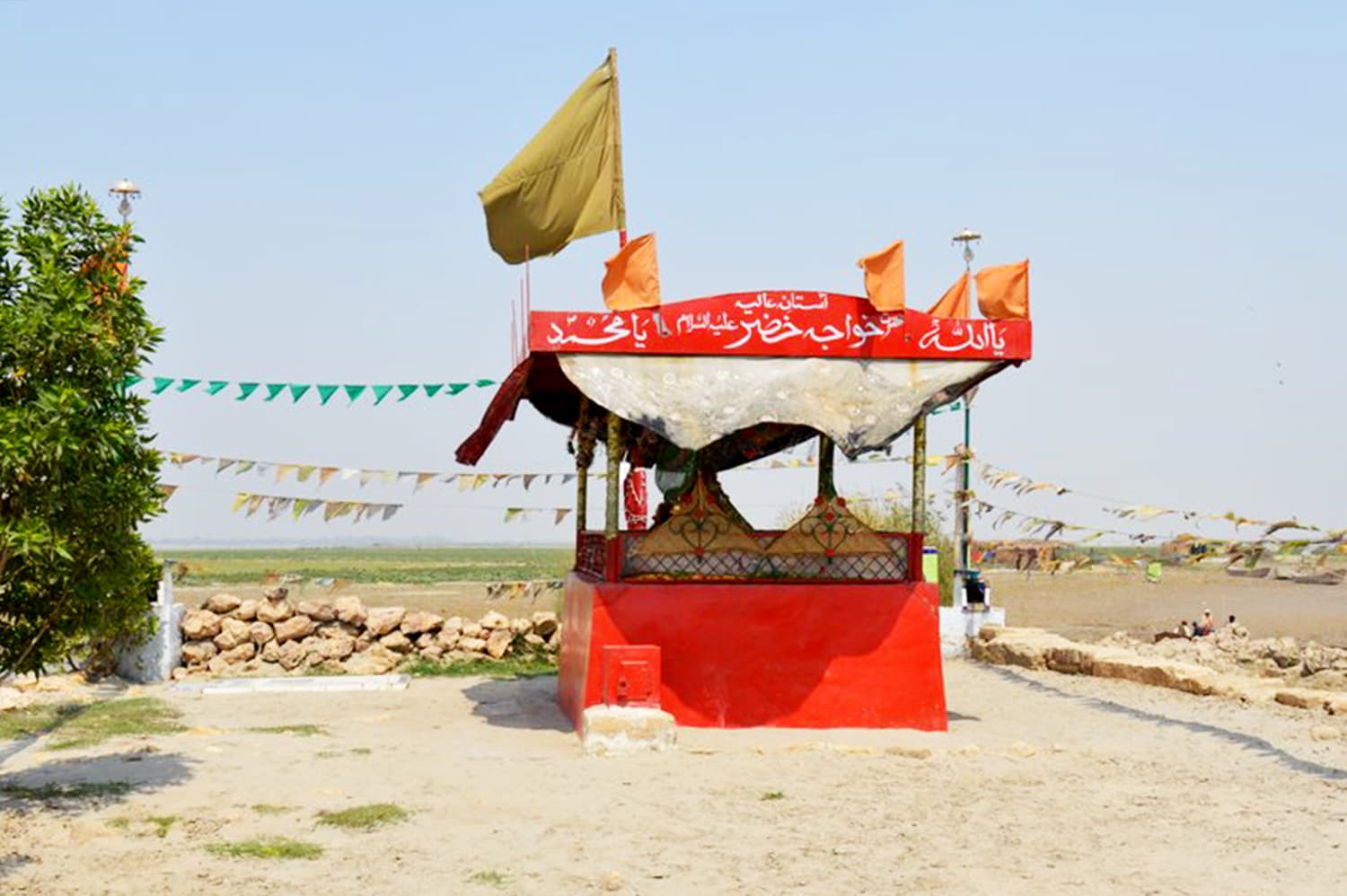
While Hindus call him Udero Lal or Zinda Pir, for Muslims he is Khwaja Khizr, and is revered by both communities as an incarnation of River Indus. His shrine or khanqah is located near the Bakhar Island in the middle of the river in Rohri.
We stopped near a sandy river bank, while the mighty Indus listlessly lapped at our feet. This once-magnificent lion river which the Rig Veda calls Sindhu and describes that “its roar is lifted up to heaven” has now been tamed by humans and turned into a muddy backwater. However, the inhabitants of the region are still devoted to it and towards its saints, one of whom is Khwaja Khizr.


After hiring a boat, we started off towards the shrine and reached a small platform that would lead us to the sanctum. Colonial writers like Major Raverty, Henry Cousens, and Richard Burton describe the shrine as an impressive structure; however the floods (in 1956 and then in the 1970’s) carried away all the superstructure and what now remains is a group of half-ruined buildings.
While there are various accounts explaining the chronology and purpose of building the shrine, there is no consensus. For example, an inscription on a slab was found in the shrine which General Haig translated in his 1887 memoir The Indus Delta Country as:
When this sublime temple (dargah) appeared,
Which is surrounded by the waters of Khizr,
He wrote this in pleasing verse
Its date is found from the court of God
The date calculated from the slab states that the shrine was built in 341 AH (952 AD). However, this is a still contested fact by historians and archaeologists.

In another version, in the historical work Tarikh-i-Tahiri authored by Mir Tahir Mohammad Nasyani, it is related that in 952 AD, a merchant from Delhi was passing through Alor (present day Aror) with his beautiful daughter, when the ruler of the city Dalu Rai happened to see her and wanted to abduct her.
The girl prayed to the saint of water, Khwaja Khizr, and he changed the original course of Indus, destroying the city and its ruler with it. Therefore, it is believed the shrine was built to honour the saint.
Currently, the shrine has a few niches and alcoves for keeping earthen lamps, a place for prayers, and a number of verses in Sindhi and Persian related to the sanctity of the water, inscribed on its walls.

The main sanctum is bordered by small walls and adorned with colourful paper streamers. There is a raised platform in the middle, which is believed to be Khwaja Khizr’s takiya or gaddi (throne or seat), and is embellished with large alams (flags or signs), which are a testament to Shia influence nowadays.
The story Khwaja Khizr doesn’t end on this small, dilapidated shrine in the middle of the Indus River. Instead, in order to fully comprehend this enigmatic persona, one has to cross the river and go to the other bank, where one finds the temple of Zinda Pir.
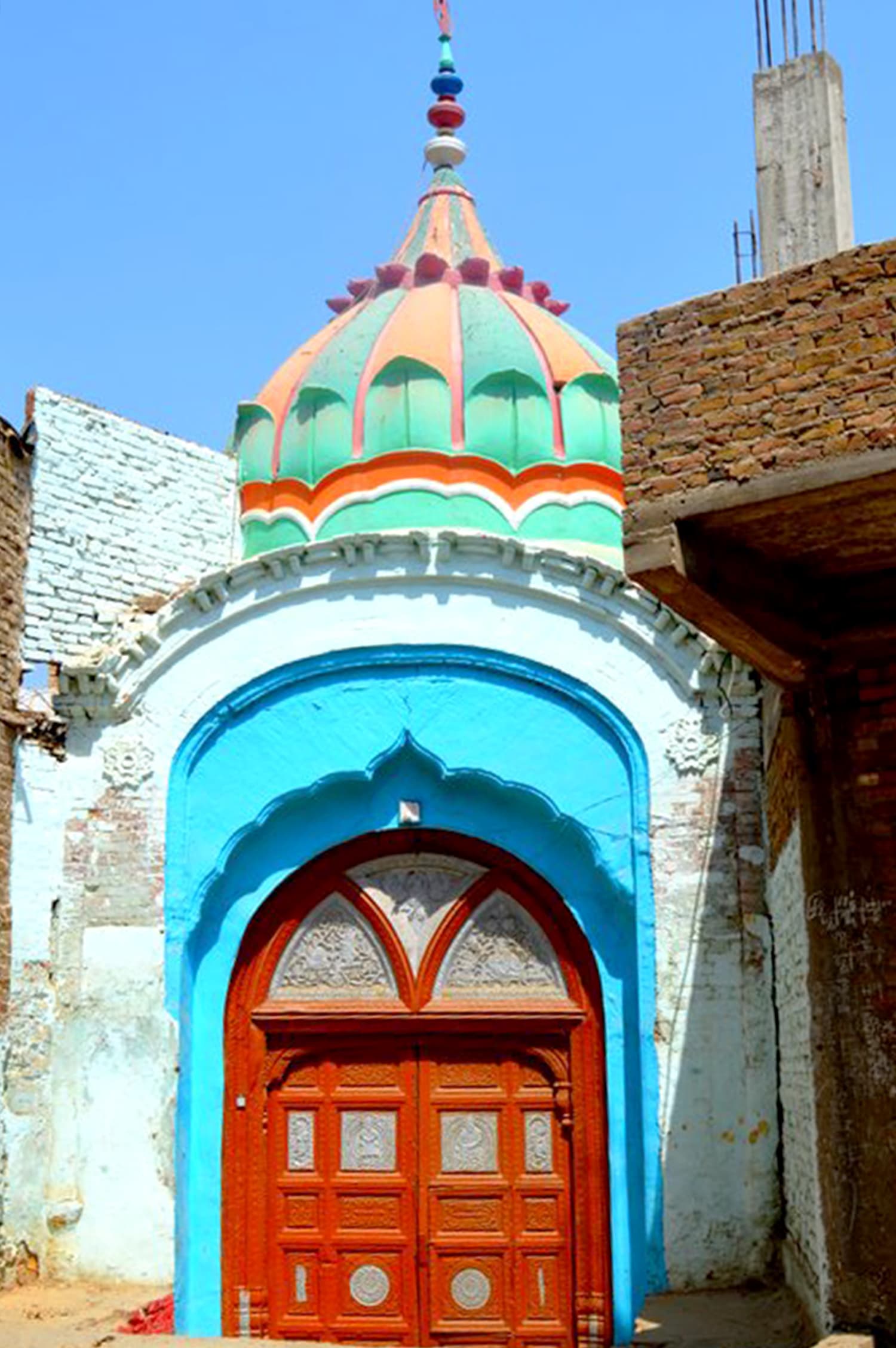
Zinda Pir's temple was constructed sometime after the 1870s. Despite revering Khwaja Khizr for time immemorial, there came a point when Khwaja Khizar was also compartmentalised into Hindu and Muslim sections.
Due to a communal disturbance, Hindus moved away and established the temple of Zinda Pir or Darya Badshah on the opposite bank.

Alice Albinia, award-winning author and journalist, in her fascinating book Empires of the Indus, provides an interesting account of the fissure between the two communities.
She notes that the 1874 Gazetteer of Sindh attested to the non-antagonistic character of the common worship there, but by the time the 1919 Gazetteer was published, Hindus had moved off the island.
According to the sajjada nashin (custodian) of the shrine, in the 1880’s Hindus filed a case against Muslims, arguing that the absence of a tomb on the shrine means that it belonged to an immortal Hindu God. Muslims argued that there is no tomb as Khizr is immortal and is still living.
The colonial authorities decided the matter in favour of Muslims. Thus, Hindus placed a lit lamp in the water and when it came ashore, they founded the temple at that spot.

Another reason that Albinia cites for the dissension between the two communities is the exclusionary politics of Hindus propelled by Bankhandi Maharaj, an Udasi saint of Sadh Belo. He encouraged Hindus to move away from Muslim saints’ shrines and establish their own places of worship.
When we reached the temple, what we saw were heaps of rubble and men engaged in construction work. I spotted an old slab adorned with green floral patterns and some Gurumukhi writing lying in rubble.
I found all this quite astonishing and asked people what was happening there. They told me that the temple was being renovated which meant that the old, beautiful colonial building had been torn down to make room for more people and modern structures.
I felt sad witnessing this modernisation of a site of such historical significance, but they assured me that old bits and pieces will be incorporated once the construction is finished.


The temple has a well and some other spaces allocated to other Hindu gods and Sikh gurus. We were told that the puja is held in a large hall upstairs so we decided to go have a look.
There was a Punjabi devotional song playing on a cassette player while some men, their head covered with rumaals, were cleaning the floor, putting things in order.
The central space is occupied by a beautiful statue of Zinda or Jinda Pir where he is shown riding his palla fish. It is believed that the brass lamps which burn here day and night are blessed by the immortal saint so if you take some oil from them and silently wish for something, it is granted.
Since I had applied for a New Zealand visa and it was being delayed, I asked one of the men whether I could make a wish for my visa to be granted. He laughed at this seemingly naïve request, but then added, “Of course, Zinda Pir sabhhni ja bera paar lagae thho” (Zinda Pir is one who leads everyone’s boats ashore), meaning he delivers all devotees from worldly ordeals.

It is said that when the Indus is flooded, the high tide reaches the temple as if to show respect for the saint. On Cheti Chand (which is the first month of Sindhi Hindu calendar, and also believed to be the Zinda Pir’s birth month) people organise a procession called behrano in which they carry oil lamps to the river and offer fruits and sweets to fish and aquatic life.
Before leaving, we were offered to have some cooked rice as prasad (food offering). I took some in my palm and moved to one of the opened windows from where one could have a breathtaking view of the Indus, the shrine of Khizar and the island temple of Sadh Belo.
It brought to my mind Bina Shah’s words, in her book A Season for Martyrs, about Khwaja Khizar’s confusion over the Hindu-Muslim divide: "Khwaja Khizr could not understand how this had happened: the land had been one for millennia".
I could not for the life of me understand this divide either. With these final thoughts lingering, as the sun set in the west, bathing both the Hindu and Muslim shrines of Khizr in its fading rays, I decided to head back.
Have you visited places of historical, cultural or religious significance? Share your experiences with us at blog@dawn.com




























