Rare is the minister who goes to parliament and briefs its members in a candid manner.
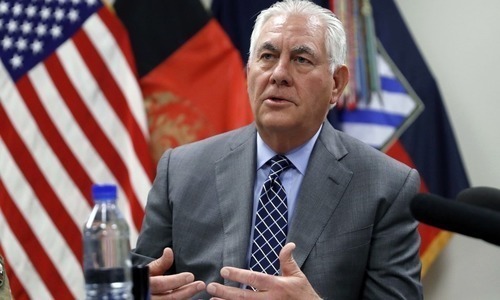
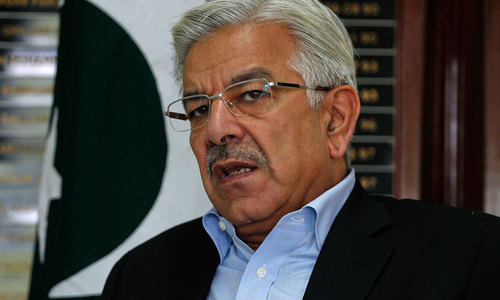
On Wednesday, Foreign Minister Khawaja Asif briefed the Senate on US Secretary of State Rex Tillerson’s trip to Pakistan and, in speaking with clarity and authority, demonstrated once again what had been missing in the Foreign Office for over four years.
Former Prime Minister Nawaz Sharif’s decision to not appoint a full-time foreign minister was one of the more perplexing mistakes of his third term. Mr Asif’s comments in the Senate, however, painted a picture of a Pakistan-US relationship that is deeply strained, rejecting the Trump administration strategy in the region as a creation of the US military and responding to a list of alleged militants that the US handed over to Pakistan by reminding the Senate that Pakistan has presented its own list to Afghanistan.
If there is a US South Asia strategy that is emerging, it appears to involve the US, Afghanistan and India acting together to put pressure on Pakistan to do more in the fight against militancy, inside Pakistan and regionally.
To push back against the unfair or unrealistic aspects of that strategy, Pakistan ought to consider drawing up its own South Asia strategy: a coordinated approach towards the US, Afghanistan and India, recognising the interconnectedness of its ties with them.
The strategy should also be proactive, suggesting what steps Pakistan can take and what it needs those countries to do for the interests of all to better align. Currently, it appears that Pakistan complains to the US about India and Afghanistan, lectures Afghanistan on India and lets bilateral problems with the latter interfere with the necessary dialogue that needs to occur on Afghanistan.
That has the collective effect of achieving very little in terms of advancing Pakistan’s interests in the region, leaving it vulnerable to concerted pressure from the US, India and Afghanistan.
A South Asia strategy by Pakistan would necessarily entail a domestic dimension too. As the foreign minister has acknowledged before, Pakistan continues to have the problem of some militant and extremist groups being able to operate relatively openly here.
Peace and stability in the region will not be established on a piecemeal basis involving one country at a time. If Afghanistan is unstable and denied peace, there are always likely to be spillover effects in Pakistan. If certain groups are allowed to operate on Pakistani soil, the dialogue with India risks being derailed by regional spoilers. If India continues to see Pakistan’s western border as a weakness to be exploited, Pakistan will be unable to broaden its fight against militancy, which is currently focused on anti-Pakistan militants.
Simply, if Pakistan is to be stable and peaceful over the long term, Afghanistan and India must reassess their policies towards this country and vice versa.
Published in Dawn, October 27th, 2017