Military pushing ahead with Afghanistan border fencing


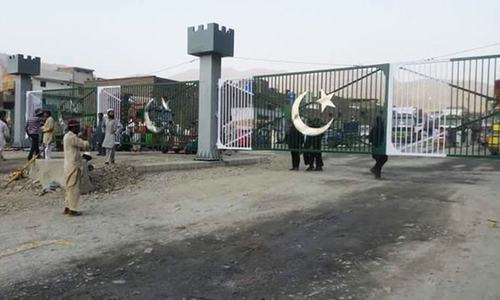
PESHAWAR: Braving cross-border firing and sniping, Pakistan’s military is pressing ahead with its plan to completely fence the 150-kilometre-long portion of the Pak-Afghan border billed as one of the most porous and perilous border regions in the world, according to a security official.
Thousands of soldiers and hundreds of vehicles are deployed at 14 different sites on a daily basis to undertake the arduous task of fencing the Pak-Afghan border — from Chitral to South Waziristan — putting in 7,000 man-hours for the installation of fabricated material.

The first phase of the project is likely to be completed by the end of 2018, which will see the fencing of 432km at the most critical points along the border.
The second phase, called “desirable”, would see the fencing of another stretch of 400km, the official said. The entire project, costing Rs10 billion, was set to be completed in the next two years.

The fence runs along some of the most inhospitable border regions, from snow-capped mountains to rugged terrains to lush green valleys. “It is going ahead day and night,” the official said.
Official says Fata needs transformation; enactment of a law alone will not bring the kind of change people there deserve
“The Pak-Afghan border fencing is now a reality. We have broken the myth that this border is so perilous that it cannot be fenced. This is a project of strategic significance,” the security official said.

The fortification of the border would be augmented by border posts and an intrusion detection system, the official said. As part of the project, 150 of the total 443 forts had already been constructed, some built on mountaintops as high as 12,000 feet, while 1,100 border posts had also been established.
Also read: Pakistan fortifies border with Afghanistan to reduce cross-border attacks
“This will serve as a strong line of defence,” the official said.
The huge undertaking has not come without human costs. Security officials say that in two months alone — July and August — an officer and a Junior Commissioned Officer embraced martyrdom on account of sniping from across the border. Three soldiers sustained injuries.
“It is tough,” a civilian construction worker who worked at the project in Mohmand tribal region said.
Wearing a helmet and bullet-proof vests, he said they would work in shifts and round the clock to complete the job. “Invariably, we would draw fire from across the border,” Dawar, who goes by one name, told Dawn.
But officials say the project is worth the human and material costs involved. “...The fallout of the war in Afghanistan in the last few decades negatively impacted us in terms of security and militancy,” the official said.
But with better border management, this would change, the official said. “There is now zero presence of militants on our side of the border region.”
The writ of the state has been restored and stability has returned to the tribal region and Khyber Pakhtunkhwa (KP), he maintained.
As examples, he cited the successful completion of census in the entire KP and Federally Administered Tribal Areas involving some 50,000 troops, conduct of the National Jeep Rally through Fata, and the Peace Cup Cricket in North Waziristan.

All this, he added, was not without effort. In the last year alone, nearly 4,000 intelligence-based operations were conducted, during which 109 hardcore militants were killed and around 8,000 arrested, including the successful operation that led to the recovery of a Canadian couple and their children from the custody of militants.
But he warned that with about 5,000-7,000 militants still sitting across the border — enjoying operational impunity and waiting for an opportunity to strike — the stability curve would continue to be contested.
“Their narrative has been defeated and their recruitment base has been meaningfully shrunk, but with their sanctuary across the border aided and supported by their handlers, they would continue to make efforts to hurt us by attacking soft targets. Bringing down terrorist incidents to zero is a desire that will take a long time to fulfil.”
However, security was just one aspect of the Fata stabilisation process, the security official said. This would have to be complemented by socio-economic investment in the region to bring it par with other regions of the country.
“Right now, Fata has the lowest socio-economic indicators in the country.”
For its part, the Pakistan Army’s 11th Corps that commands the region has undertaken several key projects of strategic nature, including the construction of 150km roads, in addition to up-gradation and construction of 693km roads to increase regional connectivity, establishment of schools, cadet colleges, vocational and technical institutes, reopening of 785 hospitals and setting up of commercial hubs and markets besides the creation of the first Agri Park of Pakistan to include warehouses and vegetable and fruit processing plants.
“Fata needs transformation,” the security official said. “A mere enactment of law alone will not bring the kind of change the people of Fata really deserve. It will require practical steps,” the official added.
Published in Dawn, December 30th, 2017