IT is possible that Kulbhushan Jadhav will go home free in 2018.
It is possible that the Pakistan government has other plans for the convicted man, spy or no spy.
All countries spy on each other. Israel spies on the US and the US spied on the German chancellor.
The CIA woman who walked away with a flash drive full of top secrets from an inaccessible alcove of Indian intelligence should be enjoying premature retirement, resting on her laurels in Hawaii or some such happening place.
The US has also hosted the RAW agent who deserted his post. Has that stopped Indian nationalists from clamouring to sit in Donald Trump’s lap?
Indians and Pakistanis are perhaps the only countries that would beat up each other’s suspected spies or, in some instances, even rough up diplomats accredited to their capitals.
A Pakistani diplomat L.K. Advani threw out over charges of spying — falsely, according to Indian diplomats — returned to visit Delhi as his country’s foreign secretary, and he continued to party with his Indian friends on both sides of the border.
Jadhav was caught red-handed if that is what happened. It is hardly unlikely that India has not pounced on one of Pakistan’s intelligence men, which some say has indeed happened — in Nepal.
If an accident doesn’t occur, this could be a fit case for a swap though we may never know of it, somewhat like Rudolf Abel’s release for Gary Powers. A Steven Spielberg fan in Bollywood may then consider an Indian sequel to the Bridge of Spies, a story told so delicately about the US-Soviet spy exchange at the height of the Cold War.
When the Indian media and parliament were berating Pakistan over the Jadhav meeting, they were being blind to how they approach their own prisoners.
Neither of the two possibilities confronting Jadhav would erase the bitter memories that my friend and fellow journalist Iftikhar Gilani carries in his heart since the fateful day in 2002 when he was arrested for several months on fictitious charges of spying. He was to be released just as inexplicably.
Nor will it undo the damage done to the fragile child that Ghalib was when his father Afzal Guru was hanged on a cold morning without the courtesy of informing his wife.
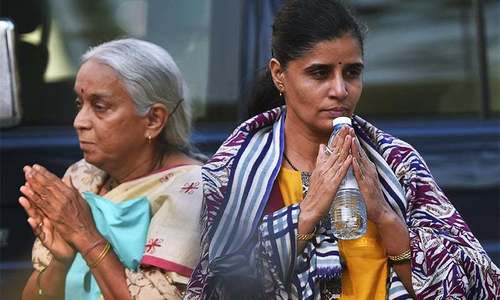
I stand firmly with the Indian critics — civilians, media analysts and MPs alike — who have slammed Pakistan for not letting Jadhav embrace his wife and mother, and for not allowing him to speak in Marathi.
The difference is that I also stand with Guru’s wife who was denied a last meeting with her husband, and son who was too small to tell the difference.
When the Indian parliament was berating Pakistan for its omissions and commissions with the Jadhav meeting, and when Indian TV channels were going ballistic about the event, they were being blind to exactly how they approach their own prisoners.
A 90 per cent crippled teacher from Delhi University is lodged in a despicable condemned men’s cell in Nagpur because he is suspected of being a Maoist. Saibaba believes he won’t come out alive.
Does one remember how vehemently Arun Shourie the journalist, before he became a politician, fought for Kehar Singh, the Sikh arbitrarily executed as a conspirator in Indira Gandhi’s assassination?
Do we care that Indira Gandhi hanged Maqbool Bhat years after he was tortured and turned into a vegetable in Tihar jail?
But Jadhav’s partisans — and I consider myself one, being an opponent of the death penalty — should read Gilani’s harrowing stories from Tihar jail in his excellent notebook of the incarceration published as My Days in Prison.
Thursday, June 20, 2002, was Gilani’s fourth day at the jail. Nobody had come for mulaqat (visit) to see him. He was worried. He did not have proper clothes and was wearing the shirt drenched in human faeces, with which he had cleaned the toilet. He went to the social welfare officer and told him the matter.
The social welfare officer was appointed to look after the welfare of the inmates. Counselling first-time inmates and informing their families was one of the important functions of the officer. The social welfare officer Sanjay Kumar told him that his wife had also been arrested and he should forget about the mulaqat. Someone should pass this chapter over to irate BJP and Congress MPs.
In the evening, a munshi came calling and asked Iftikhar to accompany him to the deodhi (entrance). He told my friend that his wife Aanisa had come and led him to the mulaqat room.
“The system of mulaqat is another horrendous indictment of our prison system as far as the human dignity is concerned,” Iftikhar Gilani records in the book. “There is a small hall-type room specifically meant for mulaqat. This room has built up enclosures having brick walls up to around three feet height and the rest of the height is covered by the grills and meshes. The inmates and their visitors have to talk to each other in a standing position.
"The room does not have ventilation sufficient enough for almost 200 people present in every mulaqat session. At one time, authorities allow 60 prisoners to see their near and dear ones for half an hour. On the other side of the meshed grills, on an average two to three persons visit one prisoner. They are almost two feet apart with thick mesh of double grills and wires parting them.”
The description of Gilani’s meeting with his wife would perhaps make Jadhav cry.
“I saw Aanisa. She was looking tired and pale. It was extremely frustrating not to be able to talk to her without the barriers. It was very difficult to see her under the watchful eyes of my tormentors. I could see Aanisa was also under great anxiety … Just getting to jail was difficult, and added to that was the incontestable humiliation at the hands of the jail staff she had to contend with.”
Need one say more?
The writer is Dawn’s correspondent in Delhi.
jawednaqvi@gmail.com
Published in Dawn, January 2nd, 2018