RONALD Goldfarb in his book The Contempt Power referred to a criminal case from mediaeval England as follows: “When King Henry the Fifth was the Prince of Wales, his servant was arrested for committing a felony. The Prince demanded that his man be let free, Chief Justice Gascoigne ruled that the laws of the realm must be met. The Prince tried physically to take the servant away, whereupon Gascoigne ordered him to behave. When the Prince did not heed this advice, he was sentenced for contempt and committed to the King’s Bench prison. People speculated whether this would be the end of Gascoigne’s career, however, it developed that the King was pleased, and rejoiced that he had a judge who dared to minister justice to his son.”
The Prince was penalised by Gascoigne not to satiate the latter’s ego; instead, it was to ensure that the streams of justice remained unsullied in the realm. Moreover, the King was convinced in all fairness whilst endorsing the verdict rendered by Gascoigne that bowing before the mighty force of law would strengthen the foundations of his rule. As in the past, even now independent and impartial institutions are indispensable for the survival and progress of any country and tinkering with them is a costly adventure. This is truer in the case of the judiciary because it is tasked with dispensing justice.
The rule of law unfolds its substance only through the courts and this fact makes it necessary that the courts perform their functions autonomously; their authority and dignity has to be jealously guarded and no class of persons should dare to obstruct the administration of justice.
The act of lowering or scandalising the authority of the court is obstruction of justice and a punishable act.
Overwhelmingly in all jurisdictions, the courts are entrusted with the power of punishing those who indulge in acts that tend to bring administration of law into disrespect or disregard. In Halsbury’s Laws of England, it is laid down that the act of lowering or scandalising the authority of the court is obstruction of justice and a punishable act.
Such power to punish is known as contempt of court; the basis of this power also exists in our constitutional framework by virtue of Article 204 of the Constitution. The said article empowers the court to punish any person who obstructs the process of the court, disobeys the orders of the court, scandalises the court or brings the judge into ridicule. Additionally, under Contempt of Court Ordinance 2003, the superior courts have been entrusted with wide powers to further advance the objective of Article 204.
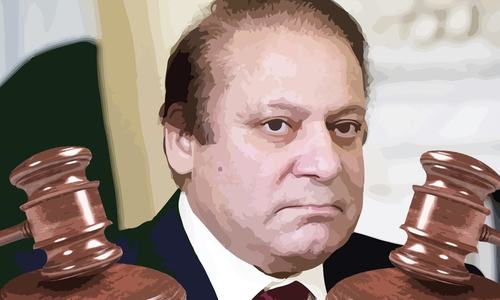
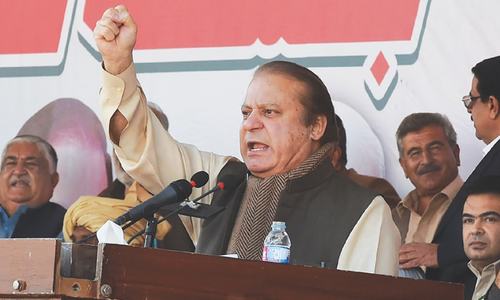
Criticism of the judiciary in developed democracies is an accepted norm and does not fall within the purview of contempt of court as long as the same is fair. Unfortunately, after the Panama Papers verdict, the ruling family has launched a crusade against the Supreme Court of Pakistan whereby criticism, couched in derogatory statements and vile threats, is being hurled at the judges. The campaign, spearheaded by the disqualified prime minister and his daughter duly aided by a small coterie, has been launched with the prime purpose of selling the narrative of ‘Nawaz Sharif’s innocence and military-judiciary conspiracy’.
Surprisingly, deliberate misinterpretation of the SC verdict and the use of extremely ill-chosen words, short of open invective, against the SC judges is neither pricking the conscience of those leveling these accusations nor attracting the apex court’s attention. The judges on the Panama Papers bench are the target of frequent scurrilous attacks on their character and impartiality, but the contumacious conduct of Messrs Sharif & Co and their cohorts is repeatedly being condoned by the apex court, even at expense of its own reputation.
Many are now sarcastically arguing that the verdicts in the Hudaibiya Paper Mills and Jahangir Tareen cases are balancing acts by the apex court. Such arguments, I firmly believe, are not based in fact; however, they do reflect the mood of a section of the public which feels that the SC is under immense pressure from Sharif’s relentless tirade. Is this ‘judicial restraint? The less said the better.
Historians assert that Excalibur, King Arthur’s sword, was the main reason for his valour and incredible combat skills. Sadly, after his death in the battle of Camlann, Excalibur disappeared and since then its whereabouts are unknown. Nawaz Sharif’s outrageous assault against the apex court and its silence reminds me of the tale of Excalibur. It appears that just like Excalibur, the sword of contempt, powerfully and effectively used in the past by the SC, has now vanished from its sheath.
Libelous attacks upon the judges are a public injury as the same instils in the minds of the masses a general discontent with the fairness of judicial determinations. The foundation of the judiciary is the confidence of the people: whenever a people’s allegiance to the courts is shaken, it is the most dangerous obstruction of justice. Admittedly the sword of contempt should be rarely used; nevertheless, when the administration of justice is under severe threat, the courts are not supposed to sit idle.
Until now, every act of magnanimity shown by the apex court is being interpreted as a weakness of the judicial system by Sharif.
The Indian Supreme Court judge, Markandey Katju once remarked, “If someone calls a judge a fool inside the courtroom and disappears, it is not contempt, for he has not stopped the functioning of the court. But if he keeps shouting in court the whole day, then he is obviously not letting the court function, and this would be contempt”.
Indisputably, Sharif’s slanderous campaign with the objective of pressurising the apex court and impairing its functioning is contempt of court; however, the question here is: when will the apex court’s Excalibur be back in its sheath?
The writer is a lawyer.
Published in Dawn, January 8th, 2018