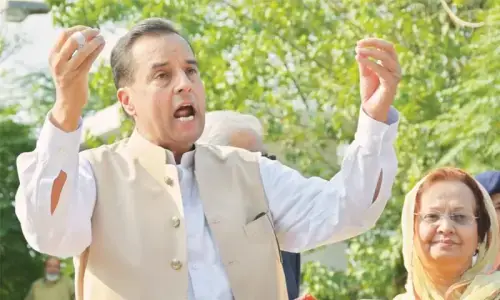
LAHORE: Calling for reforms, transparency and strengthening regulatory mechanisms for industries, speakers at a session on the China-Pakistan Economic Corridor and the economy at the Lahore University of Management Sciences (LUMS) on Saturday highlighted the need to ensure political and economic stability to invest in labour and to improve coordination between the Centre and the provinces so that Pakistan could harness the advantages of China’s Belt and Road Initiative (BRI).
Nazish Afraz of LUMS spoke about special economic zones, which are to be built as a part of the CPEC, and what kind of policies would allow the government to attract investors. She identified certain areas which needed to be improved: access to finance, tax administration, inspection compliance, uninterrupted electricity supply, and contract enforcement, among others.
She urged the government to consider developing clusters of economic activity in a network centred on the main CPEC arteries, and compared the experiences of special economic zones in Shenzhen in China and in Senegal (Africa) and in Maharashtra in India.
“Investors consider investment incentives as icing on the cake, rather than as decisive factors when considering investing their money in another country,” she said, and suggested that the government consider dispensing back-loaded and performance-based incentives to investors rather than handouts.
At another session on the Geopolitics of the CPEC and BRI, William Case of the University of Nottingham shared the experiences of Malaysia to draw certain cautionary lessons for Pakistan. Warning about unfavourable terms of lending, he added that: “China has always opposed democratic reform and doesn’t need political stability to be a major factor in the countries it brings investments to.”
He also cautioned that through the BRI, China would leverage its economic dominance for democratic concessions, and warned of the possibility of a military coup in Pakistan.
Speaking about the possible impact of the BRI on Pakistan’s foreign policy, Prof Yunas Samad said historically, Pakistan had structured its foreign policy mainly around the US, India and Afghanistan. It would be interesting to see how the BRI would impact regional security in the years to come.
Published in Dawn, April 8th, 2018