FOR any foreign tourist, the picturesque Kashmir Valley is a place of attraction and a picture-perfect honeymoon destination too. Srinagar’s Dal Lake is in the lap of a mountain range. The wooden houseboats, old-style shikaras, chinar trees and floating gardens inside the water body add life to the days of a holidaymaker and also add romance to the lake.
The sunrise and sunset there inspire many to write romantic poems à la Faiz and Faraz. The short mountain range Zabarwan overlooks the famed lake and also the Mughal gardens — the Nishat and Shalimar. It is said that Dr Muhammad Iqbal wrote his famous poem Saqinama, in Persian, at Nishat garden.
Valley of death: Being young and restless in Kashmir
Everything appears perfect if one were to talk only about Kashmir’s natural beauty. But there is also a hell in this paradise.
The other day I and my journalist friend, Naseer, were on a leisurely walk along the Jhelum embankment. As we reached the city centre Lal Chowk, which is named after Moscow’s Red Square, we both looked at the clock tower with anxiety. It seemed time had frozen, as if nothing was moving.
“This city looks haunted,” Naseer said. Nodding in agreement, I said: “As if something bad is about to happen.”
People often look at the clock tower at Lal Chowk. There is a history lesson here.
As schoolchildren, we often heard about Lal Chowk and how leaders like Sheikh Abdullah and independent India’s first prime minister, Jawaharlal Nehru, made historic speeches there.
Some in Kashmir who favour a palatable solution to the problems want the clock to turn backwards to 1953 when India-held Kashmir enjoyed some form of autonomy, with its own prime minister, Sadr-i-Riyasat, flag, constitution, etc. New Delhi only controlled foreign affairs, defence, currency and communications then.
But a historic humiliation followed the historic speeches made by the Sheikh. On August 8, 1953 he was unceremoniously dismissed as prime minister and sent to jail. By the mid-1960s, Kashmir had lost whatever autonomy it enjoyed.
Delhi followed a policy of deception and relied on manipulation, broken promises, a series of rigged elections, and suppression of dissent by using force. It invested heavily in three families to cultivate a crop of collaborative class and beneficiaries who represented Delhi in Kashmir.
After the eruption of a popular uprising in 1989 it seemed that even collaboration won’t work for India. The 1989 movement driven by civilian sentiment was a follow up to the political Plebiscite Front Movement.
Delhi used brute force and its armed forces indulged in massacres of civilians (at Gowkadal, Hawal, Bijbehara, Zakura, Sopore, Kupwara to name a few) to crush popular dissent in the 1990s.
In the valley renowned for its beautiful alcove of almonds, orchards of apples, and fields of saffron, the concertina wires and barbed wires placed outside the ugly, concrete bunkers of Indian armed forces have been the fastest growing vegetation in all seasons since the 1990s.
Srinagar continues to haunt the natives. In south, north and central parts of Kashmir, a huge military footprint in civilian areas makes the entire valley look like a battlefield.
On May 5, a Saturday, Srinagar again looked haunted. By 8am, the mobile phone and data internet stopped working. The cellular phones just said: “There is an encounter going on in Chattabal, Srinagar.”
By early afternoon, police claimed to have killed three militants. One of them was a resident of Srinagar. As protests broke out, one civilian was mowed down by a police vehicle in downtown Srinagar.
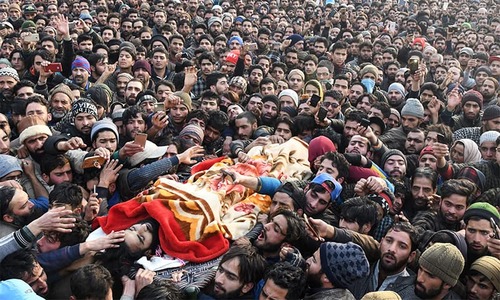
A sea of mourners offered funeral prayers of all four persons at Srinagar’s Jamia Masjid at Nowhatta and then a huge procession was taken out from there to the martyrs’ graveyard situated in Eidgah for burial.
“The scenes are reminiscent of the 1990s. A sea of people, pro-freedom slogans, bikers waving Pakistani flags, stones,” said another friend who lives in downtown Srinagar.
The next day, government forces killed 10 more people in south Kashmir’s Shopian area. Five of those killed were civilians. At least 40 others were admitted to various hospitals with bullet and pellet injuries.
As usual, the Hurriyat Conference gave a call for a strike across Kashmir. But after three days, people were asked to resume ‘normal’ lives, perhaps in wait for another cycle of violence; another bloodshed.
This is Kashmir’s normalcy. Kashmiri children have a new vocabulary: curfew, cordon, crackdown, search operation, custodial killing, bullet, pellet, mujahid, military, funeral, gun salute, hartal, and ‘normalcy’.
India’s Army Chief General Bipin Rawat has in an interview with The Indian Express said: “I want to tell Kashmiri youth that Azadi (freedom) isn’t possible. It won’t happen. Don’t get carried away unnecessarily. Why are you picking up weapons? We will always fight those who seek Azadi, those who want to secede. (Azadi) is not going to happen, never.”
In saying so, General Rawat has made a candid admission about the dominant idea and deep-rooted aspiration on Kashmiri turf. Though he has spoken from a position of power and made an argument of power with a colonial mindset, he has conceded that “there isn’t a military solution to this issue”.
Government forces have killed 432 militants and 235 civilians in Kashmir since 2016. Since a popular uprising in 2008, over 600 civilians have been killed in street protests. This is our normalcy. And mind you, Kashmir is indeed beautiful!
Published in Dawn, May 11th, 2018