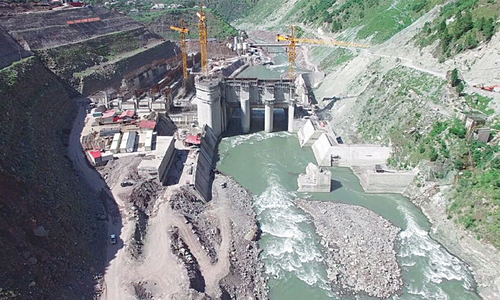
THE dispute revolves around a hydroelectric power plant on the Kishanganga River, which is a tributary of the Jhelum and is known as the Neelum in Pakistan.
On Saturday, Indian Prime Minister Narendra Modi inaugurated the project — which includes a dam on the tributary — barely metres away from the Line of Control in the disputed Kashmir region.
The project will generate 1,713 million units of electricity per year. The dam will divert Jhelum waters to an underground power house. To do so, it will transfer the water from the Gurez Valley back into mainland Kashmir, instead of allowing it to flow into Pakistan.
The Kishanganga River flows through the regions of Neelum in AJK and Astore before entering the India-held region of Gurez. The dam will give India control over a river that flows from Pakistan into India-held Kashmir and then re-enters Pakistan.
What is Pakistan’s position?
Islamabad argues that the 1960 Indus Waters Treaty (IWT) gives Pakistan control over the waters of the Indus, Chenab and Jhelum Rivers.
The treaty gives India control over three eastern rivers — Beas, Ravi and Sutlej. India may also use the waters of the western rivers in “non-consumptive” ways. It interprets this as a permission to build “run-of-the-river” hydel projects that do not change the course of the river and do not deplete the water level downstream.
Pakistan argues that the Kishanganga project violates both conditions by changing the course of the river and depleting the water level.
What steps did Pakistan take to stop India from building the Kishanganga dam?
India started work on the project in 2007. In 2010, Pakistan took the matter to the Permanent Court of Arbitration at The Hague, which stayed the project for three years. But in 2013, the court ruled that the Kishanganga was “a run-of-the-river plant within the meaning of the Indus Waters Treaty and that India may accordingly divert water from the Kishanganga (Neelum River) for power generation”.
Room for Pakistan
The court also ruled that India was under an obligation to “construct and operate” the Kishanganga dam in such a way that it “maintains a minimum flow of water in the river”. The minimum flow was fixed at 9cumecs, a unit of flow equal to one cubic metre of water per second.
India declared that it was lowering the height of the dam from the planned 98m to 37m and resumed construction at full swing. Pakistan, however, collected evidence to prove that India was violating the treaty as well as the court’s verdict.
Pakistan seeks World Bank’s arbitration
In August 2016, Pakistan asked the World Bank to appoint a court of arbitration to review the designs of Kishanganga and another project on the Chenab, called Ratle. India rejected the suggestion, saying that Pakistan’s objections were technical in nature and that the matter should be decided by a neutral expert.
Pakistan disagreed, arguing that a decision by a technical expert was non-binding and India would be under no obligation to implement the expert’s recommendation.
The World Bank set in motion both processes but paused them when India and Pakistan refused to withdraw their proposals. After the pause, the bank held several rounds of talks — the last of which took place in September 2017 — but failed to resolve the dispute.
Pakistan’s latest move
After India announced last month that it was commissioning all three units at Kishanganga, Pakistan wrote to the World Bank demanding that it ensured India abided by the treaty.
It is now sending a high-level delegation to the United States for talks with the World Bank. The delegation, led by Attorney General Ashtar Ausaf, will reiterate Pakistan’s demand to constitute an international court of arbitration.
Neelum-Jhelum project
Unable to stop India, Pakistan countered Indian aggression by building its project on the Neelum River and last month Prime Minister Shahid Khaqan Abbasi inaugurated the first unit of the Neelum-Jhelum Hydroelectric Project.
Zojila Pass
Mr Modi is also inaugurating the 11,578-foot-high Zojila Pass tunnel, which will allow India to monitor the China-Pakistan Economic Corridor.
Published in Dawn, May 20th, 2018