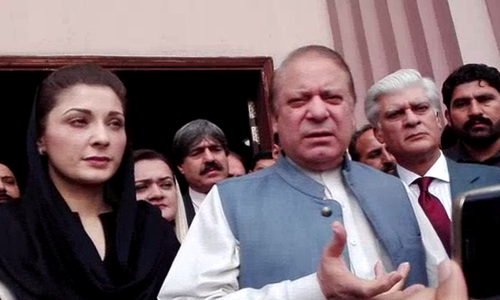
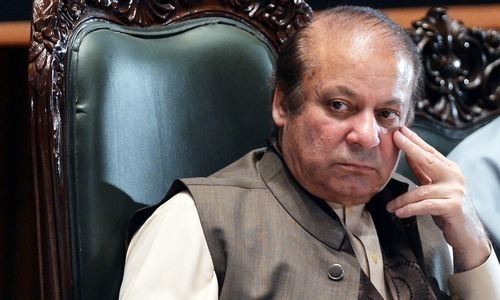
LAHORE: A single-member bench on Thursday referred to the Lahore High Court chief justice a petition challenging the conviction of former prime minister Nawaz Sharif and his family members under the National Accountability Ordinance (NAO), 1999, for constitution of a larger bench to decide the matter.
Justice Ali Akbar Qureshi observed that legal points raised in the petition were important in nature and required to be heard by a larger bench.
Senior lawyer A.K. Dogar filed the petition assailing the conviction of the Sharifs besides challenging the existence of the NAO.
The lawyer pleaded that former premier Nawaz Sharif and others had been convicted by a court which had no jurisdiction because the law under which it (court) had been created was a dead law.
He said the high court should suspend the operation of the accountability court’s judgement for being a court established under a non-existent law.
Questioning the validity of the NAB law, Mr Dogar argued that the ordinance had been promulgated by military dictator Gen Pervez Musharraf under the Provisional Constitution Order (PCO) No 1 of 1999 as well as Order No 9 of 1999.
He said the order No 9 was promulgated only to amend PCO No 1 of 1999 by inserting Section 5A (1) into it to the effect that limitation of 120 days prescribed under Article 89 of the Constitution to any ordinance by the president would not be applicable to the laws made under PCO No 1 of 1999.
He said that under Article 270-AA of the Constitution through the 18th amendment, the PCO No 1 of 1999 was declared without lawful authority and of no legal effect. He argued that once the PCO No 1 was declared without lawful authority and of no legal effect, the amendments to it made under order No 9 of 1999 would also stand lapsed and, therefore, the limitation period of 120 days prescribed under Article 89 would be applicable to the NAB ordinance.
Advocate Dogar asked the court to declare that after the 18th Amendment and insertion of Article 270-AA into the Constitution, the NAB ordinance had ceased to be the law and become non-existent and a dead letter.
He stated that thousands of people had been suffering from the agony of proceedings under a law which was constitutionally non-existent. Therefore, he said, all these proceedings should also be declared unlawful.
Published in Dawn, July 20th, 2018