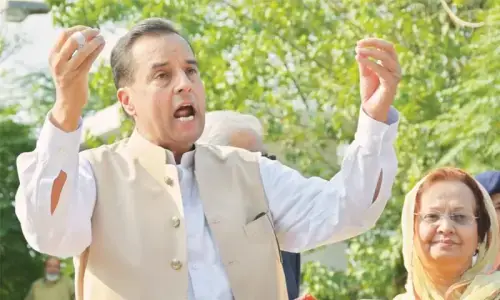
LAHORE: When it comes to metaphors surrounding politics, the umpire is meant to represent the will of the people, said human rights activist Hina Jillani on Saturday.
“But there is a stranger on the pitch who is calling the shots.”
She was speaking at a seminar titled ‘Who should we vote for’, organised by the Progressive Students Collective. Ms Jillani was joined by journalist Raza Rumi and historian Ammar Ali Jan, who discussed various aspects of the history of electoral politics in the country and how they can inform people’s choices of who to vote for.
“We need to investigate what democracy means for this country,” Mr Jan asserted, adding that the idea of equality lay at the heart of the concept of democracy. If a so-called democratic government only strengthened a certain class and offered them a decent life while ignoring the majority of people in a country, could it even be called democracy, he questioned.
Democracy comes with a package of values and important elements, such as the elections, Ms Jillani said. She appreciated that the upcoming elections would provide an opportunity for peaceful transfer of power from one civilian government to another, but added it wasn’t merely a farcical “functional” democracy that the country should aspire.
She regretted that political parties had not spoken up for the restoration of student unions or how to strengthen trade unions.
Pakistan’s civil-military bureaucracy had been active since its inception to subvert the democratic process, regretted Mr Rumi, recalling instances in which a military dictator had termed Fatima Jinnah a “traitor” and an “Indian agent” who wanted to create a separate Pashtunistan. Similarly, in the 1970 elections, the establishment had wanted a powerless hung parliament.
“At the time, Bhutto became the establishment’s ladla [favourite] and we all know who the ladla in this election is,” he said.
Mr Jan added that when Awami League came to power in East Pakistan in 1970, the country’s elite, represented by the establishment, were willing to give up an entire portion of the country to keep their power in intact. In previous elections, when politicians shuttled from one party to another, they were referred to as lotas but in this election, they’ve been termed electables.
“The strength of an electable depends on how many favours they can give their voters... in a way an electable is a powerful person who can overpower the system, but they never raise their voice or fight for people’s rights, they keep reproducing the same social structures,” he said.
Mr Rumi deplored that the impression that most politicians were corrupt and greedy had been created so that people would loathe the political class. A distorted version of history had been used to inject poison in Pakistan’s social fabric against politicians, he said.
Ms Jillani exhorted the students saying, “Never feel burdened, we have to make a difference, we can and we will.”
Published in Dawn, July 22nd, 2018