‘Pakistan’s labour laws do not create enabling environment for women’


ISLAMABAD: A gender audit of Pakistan’s labour laws has found that they do not create an enabling working environment for women and suffer from inconsistencies in the definitions of labour and labour rights, among other problems.
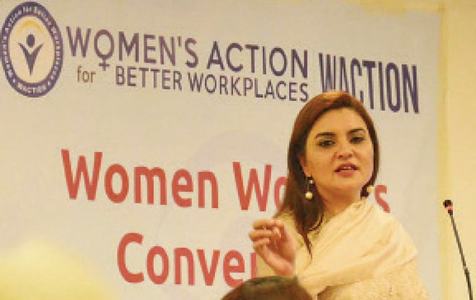
The audit was carried out by Women’s Action for Better Workplaces and its findings and recommendations were revealed at an event attended by parliamentarians, political workers, civil society and working women from various fields on Thursday.
One of the organisers, Jublee Bano, said legal experts were consulted for the audit, as were scholars and parliamentarians and workers from the provinces.
Discussing the findings of the audit, a representative of the forum Rukhsana Shama said Pakistan’s constitutional provisions and international commitments were consulted to devise a criteria through which the existing labour laws could be analysed. These categories included freedom of association or freedom to bargain collectively, wages, occupational safety and health, protection against sexual harassment in the workplace, equality of work and opportunities for women and maternity leave and benefits, among others.
The audit found that labour laws do not effectively combat various forms of discrimination against women, including more subtle forms of discrimination against women based on their age, marital status and reproductive role.
Ms Shama said that while laws do combat overt forms of discrimination, for example firing a pregnant woman, they do not cover “subtle discriminations” that are not documented and are a reflection of the social psyche. For example, there are fields in which women above a certain age are not hired. She added that women they spoke to said employers ask women in interviews whether they intend to get married, and if they are married, what their plans are for children.
There were also no measures to enable women to enter fields with lower representation of women, nor incentives for employers to hire more women.
Ms Shama said the workplace sexual harassment law is not mentioned as a labour law in labour law manuals. Labour departments are also not aware of the law’s importance when considering the conduciveness of a workplace for women.
Labour laws lack legal provisions for paternity leave, and other than the Sindh Maternity Benefits Act, laws do not legally permit breastfeeding breaks. The provision of daycare centres and flexible timings for women and men with children are also missing.
The audit also found inconsistencies in the definitions and rights of labour. Ms Shama said there are nine definitions of ‘labour’ across legal and policy frameworks, and these inconsistencies came forward after the 18th Amendment.
The presentation noted that the definitions of workers “do not account for growing economic sectors - electronic media, hospitals, private schools” and drivers for ride-sharing services.
Ms Shama said labour rights and entitlements are also inconsistent. The minimum wage does not cover all types of works, and there are inconsistencies in social security as well. She added that there are also issues with maternity laws - there are seven maternity laws that do not contain provisions for adoption, and have inconsistent provisions for complications and varied durations of maternity leave.
Ms Shama also discussed the problems facing the labour administration and inspection system. She added that while the labour inspection checklist looks comprehensive on paper, it only covers a few fundamental matters, such as the minimum wage, working hours, weekly holidays and so on.
The representation of women in the labour department is very low, and as inspectors is virtually nonexistent, she added.
She said employers should be penalised for violating labour laws, and given incentives such as tax breaks for complying with them.
A panel discussion followed in which parliamentarians belonging to various political parties took part.
They discussed the importance of extending labour laws to the informal sector, which has a significant percentage of women workers, as well as the need to focus on the implementation of laws rather than just law-making.
They also noted that gender is relevant across the board, and instead of relegating such matters to be ‘women’s issues’, women’s issues should be considered across every sector.
Published in Dawn, October 26th, 2018
Download the new Dawn mobile app here: