Women on bikes have right of way in Pakistan. But only if they are white


I have been an avid cyclist for over three years and on my cycle, have explored areas of Lahore I would have never seen otherwise.
Needless to say, it is one of my favourite pastimes and has added a lot of positivity to my life.
I quickly realised that this feeling of liberation was something I wanted to share with other women and have since been advocating for the cause and have been managing a group of female cyclists known as Girls on Bikes.
Now, all of that sounds great and has received its fair share of media attention. But, the fact of the matter is that pictures never portray the effort it takes for Pakistani women to get on the road and the strength they need to stay on it.
Misogyny on wheels
In March 2017, I had my first terrifying brush with street harassment while cycling.
“Zara smile to karo na, meri taraf hi dekh lo”, he kept insisting from behind as I pedaled, legs shaking, through the residential streets in the posh Cavalry Ground area.
Petrified at the prospect of him intercepting me or ramming his motorbike into my cycle, I decided to stay mum and ignore him completely.
Of course, this did not deter the slimy person in the least. He continued: “Hum baat to kar sakte hain na, tum mute ho gaee ho, koi jawab to do”.
I turned towards Cantt., hoping he would disappear. Flustered, I told the army men at the check post that a man on a motorbike was harassing me.
It made no difference; the miscreant dodged the guards and went straight ahead.
He continued to follow me for another kilometre, spewing filth in broad daylight in one of the most heavily monitored areas of the city.
Related: What is it about a girl cycling that says 'come harass me'?
What I faced was actually nothing compared to what happened to two other women cyclists I know.
On separate occasions, the women were purposely rammed into by groups of men in their vehicles.
The incidents occurred in the upscale Defence Housing Authority and, in both cases, the perpetrators walked away scot-free, leaving the cyclists injured and traumatised.
Street harassment in Pakistan is a serious concern. Women are groped and catcalled regardless of age or clothing.
A female cyclist is the most vulnerable. While on a cycle, all four limbs are engaged and do not easily allow for any action like reaching for a cell phone and, due to slower speed, make it harder to flee the scene.
Harassment is the main factor preventing women from stepping out and also the reason why families are unsupportive of girls taking up cycling.
Harassment does not stop here; it transitions from streets to social media, where photos of Pakistani girls on cycles receive torrential abuse from mostly men.
Read next: 'Cycle chalao, patriarchy dubao': Taking to Karachi streets without the company of men
Moreover, the availability of cycles is also a problem; the old cycle market at Neela Gumbad sells low quality bikes for exorbitant prices.
There is a niche market for buying and selling (often smuggled) cycles online through Facebook groups.
Nonetheless, finding a good cycle is difficult and quite heavy on the pocket with basic models starting at Rs15,000 and high-end racing cycles costing up to a million rupees.
Given these limitations, women comprise between 10% to 20% of the already small cycling community in Pakistan.
Yet, I can safely say that the number of women interested in the activity is growing and even the ones who have faced harassment have not let the experience stop them.
Right of way for Westerners only
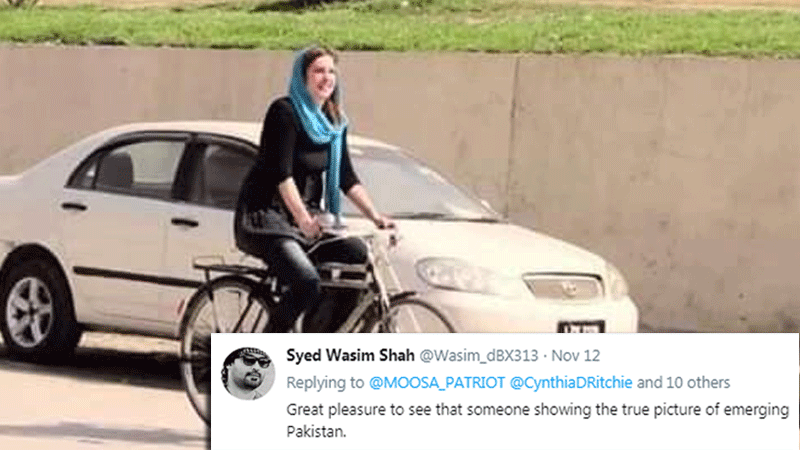
Recently, a photo of Cynthia Ritchie, an American documentary director/producer based in Pakistan, riding a cycle in Peshawar went viral, with captions appreciating representation of the country in a positive light.
Pakistani feminists and cyclists have multiple issues with this portrayal by the white lady in question.
Pakistanis have a tendency to bend over backwards in their attempts to facilitate Westerners, an effort that lies somewhere between hospitality and a serious post-colonial inferiority complex.
Added to Cynthia’s privilege, the photo is performative to the extent of being cringeworthy. No pedestrian or bystander is in sight as she pedals with ease.
The photo is in no way representative of the concerns and struggles of Pakistani women’s attempts to reclaim public space.
To attack Cynthia for completely lacking self awareness about her privileges would be unfair on my part and, instead, I choose to assume positive intent.
Her experience deserves depiction but the attempt to turn it into how liberated women in Pakistan are left me scratching my head.
A white woman pedaling a cycle, sitting on the driving seat in a rickshaw and posing next to a truck in a dupatta is how Pakistan will be seen positively by the world? Is this really how low we set the bar for Westerners?
And why are Pakistani women fighting for their rights at the receiving end of so much vitriol? Why is only an image of a white woman on a cycle celebrated for showing a positive Pakistan?
Conversations around women’s mobility in public space have taken centre stage in recent years. Communities on social media have helped raise awareness, government campaigns have provided women with motorbikes and research organisations are working on issues of women’s mobility.
Despite the fact that there is a long way to go before our cities become safe and welcoming for women, the progress that has been made is solely due to Pakistani women — and they are the only ones who deserve credit for it.
Are you a woman who rides bikes in Pakistan? Share your experiences with us at blog@dawn.com