India deserves no relief in Jadhav case over 'failed response' to espionage evidence: Pakistan to ICJ


Pakistan on Thursday said India had demonstrated an abject failure to respond to evidence of espionage against its serving navy commander Kulbhushan Jadhav, and requested the International Court of Justice (ICJ) to dismiss New Delhi's claim for relief on the grounds of its unfair and unrealistic approach.
The 15-member bench at the Peace Palace seat of the UN's top court concluded its four days' consecutive public hearings of the case, held from February 18 to 21, during which India and Pakistan made oral submissions for two days each.
President of the bench Abdulqawi Ahmed Yusuf declared that the court will now retire for deliberations with the date of judgement to be announced later. However, he asked the agents of Pakistan and India to remain at ICJ's disposal for further information, if required.
During Pakistan's second and final round of oral submissions in the Indian spy's case, English Queen's Counsel Barrister Khawar Qureshi made a number of arguments to point out India's weak grounds on Jadhav's fake passport, his "fictional account" of abduction and unlawful claim for consular access under Article 36 of the Vienna Convention.
Responding to yesterday's claims of Indian counsel Advocate Harish Salve, Barrister Qureshi said India was challenged to find any discrepancy in the facts presented by Pakistan, and it had failed to do so.
He termed the report submitted by India's military law experts as "irrelevant" and something which needed to be "completely disregarded".
On India's assertion that the case was only about denial of consular access to Jadhav, he said India's accusations were devoid of any evidential basis.
Regarding India's failure to identify any attempt to engage with Iranian authorities with respect to the kidnapping "fiction" of Jadhav, he said that the point was left completely unexplained as providing an explanation would have exposed the story.
He said India's assertion that there was no need to address the passport issue as it had no legal consequence, if accepted, would allow a serious transgression of the duty of good faith and fundamental international obligations to go unchecked.
He termed as "plainly wrong" India's claim for consular access under the Vienna Convention, unless India contended that Article 5(a) (compliance with international law) of the VCCR and Article 55 (non-interference in the internal affairs of the State) had no meaning.
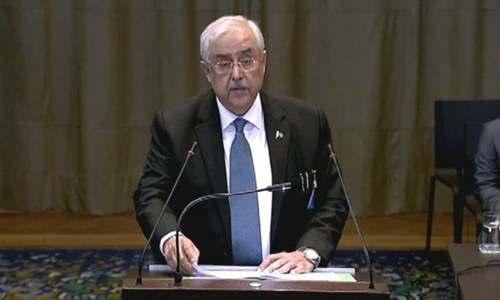
Pakistan's attorney general and agent, Anwar Mansoor Khan, in his closing statement expressed satisfaction that Pakistan's ad hoc judge Tassadduq Hussain Jillani had recovered from illness and was able to attend the hearing today.
On India's criticism of Pakistan's judicial system, he said the latter had a very robust judicial review and reconsideration system through various levels of courts. However, he said due to state secrets, some of the cases could not be heard in open court.
He referred to India's trial of Afzal Guru and also the Samjhauta Express tragedy in which 42 Pakistanis were burnt alive, saying they showed unfairness in India's judicial system.
On the recent Pulwama incident in Indian-occupied Kashmir, he said India had become the judge and executioner at the same time, calling itself the victim without any evidence. Pakistan has the right to ask for proof, he stressed.
The attorney general also mentioned the horrific human rights violations in occupied Kashmir including the use of pellet guns, rape, and abductions, which he said showed well the justice denied by India despite being asked by the United Nations for an inquiry through its report.
He emphasised that military courts in Pakistan were protected under its Constitution and pointed out that the FIR registered against Jadhav was with police, a civilian authority.
FO Director General South Asia Dr Mohammad Faisal, in the capacity of co-agent, and other senior officials of the Pakistan government were also present in the courtroom.
From the Indian side, Counsel Harish Salve and Joint Secretary of Ministry of External Affairs Deepak Mittal also attended the hearing.
Jadhav was arrested on March 3, 2016, in an intelligence operation from Balochistan's Mashkel area.
India on May 9, 2017, had invoked the jurisdiction of the ICJ following the death sentence handed to Jadhav by a Pakistani military court on charges of espionage and sabotage activities in Karachi and Balochistan.