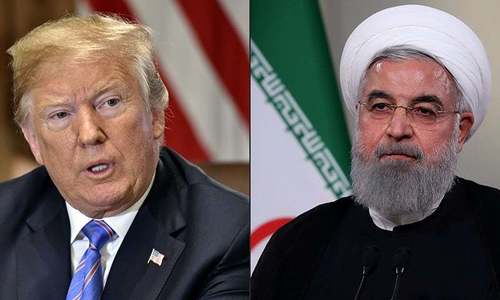
From 'threats' to military deployments: how US-Iran tensions escalated


From United States military deployments, to alleged “threats” from Iran, and attacks on oil tankers and installations, here is a timeline of escalating tensions in the Gulf:
'Credible threat'
On May 5, White House national security adviser John Bolton announces the Pentagon is sending the USS Abraham Lincoln carrier group and a bomber task force to the Middle East.
A day later Patrick Shanahan, acting defence secretary, says the deployment is “in response to a number of troubling and escalatory indications and warnings” related to Iran.
On May 7, the US says it is deploying B-52 bombers to the Gulf, followed by the Pentagon saying it will position a Patriot missile battery and an amphibious assault ship in the region.
Sanctions against Iran
On May 8, Iran says it is preparing to increase enriched uranium and heavy water production as part of its decision to stop some commitments made under the 2015 nuclear deal with major world powers.
A year to the day after Washington unilaterally withdrew from the deal, reimposing sanctions on Tehran, US President Donald Trump announces new measures against Iran's steel and mining sectors.
Explore: Pakistan’s Iran conundrum
Acts of 'sabotage'
On May 12, two Saudi oil tankers and two other ships are damaged in mysterious “sabotage attacks” off the emirate of Fujairah, part of the United Arab Emirates.
Fujairah port is the only Emirati terminal located on the Arabian Sea coast, bypassing the Strait of Hormuz, through which most Gulf oil exports pass.
Iran, which has repeatedly threatened to close the strait in case of a military confrontation with the US, calls the incidents “alarming and regrettable”.
Also read: Persian Gulf tensions, unclear threats raise risks
No 'war'
On May 13, European signatories to the nuclear deal meet with US Secretary of State Mike Pompeo. Britain warns of the risk of conflict erupting “by accident” in the Gulf.
The day after, Pompeo says: “We fundamentally do not see a war with Iran”.
Iran's supreme leader Ayatollah Ali Khamenei says “there is not going to be any war” with the US.
Drone attacks near Riyadh
On May 14, Yemen's Houthi rebels carry out drone attacks near Riyadh, shutting down a key Saudi oil pipeline which stretches from oil-rich Eastern Province to the Red Sea.
Two days later Saudi-led coalition air strikes hit the rebel-held Yemeni capital Sanaa.
US diplomats leave Iraq
On May 15, the US orders all non-emergency staff to leave its embassy in Baghdad and consulate in Arbil, due to an “imminent” threat from Iranian-linked Iraqi militias.
Germany and the Netherlands say they are halting their training of soldiers in Iraq.
'Deterrence'
Trump issues an ominous warning to Iran on May 19, suggesting that if Iran attacks American interests, it will be destroyed.
“If Iran wants to fight, that will be the official end of Iran. Never threaten the United States again,” Trump says in a tweet.
On May 21, Pompeo says it is “quite possible” Iran was responsible for mysterious sabotage incidents of oil tankers off the UAE or drone strikes on a Saudi crude pipeline.
“This is about deterrence, not about war. We are not about going to war,” says Shanahan the same day.
On May 24, the US announces it is deploying 1,500 additional troops to the Middle East to counter “credible threats” from Iran, a move Tehran denounces as “a threat to international peace”.
No regime change
On May 27, during a visit to Tokyo to meet the new Japanese Emperor, Trump says the US is not seeking “regime change” in Iran.
The Islamic republic “has a chance to be a great country, with the same leadership. We're not looking for regime change, I want to make that clear.
"We're looking for no nuclear weapons,” says Trump.