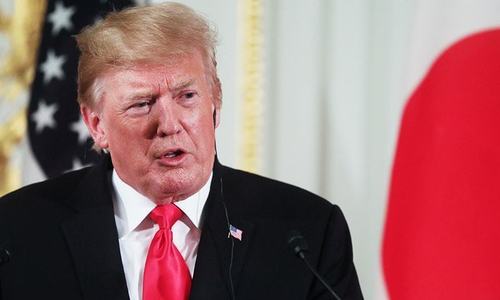
THE world is not yet ready for a third world war. President Donald Trump is.
At his inauguration in 2017, many wondered how long it would take Trump to realise that he was president of all 50 states, and also commander-in-chief of the most formidable war machine history may every see. He came close to using it recently in a strike against Iran but, as he admitted, was deterred 10 minutes before the giving the final order — not by his Cabinet or his National Security Council, but by the advice (it is said) of a tele-news anchorperson.
Is this to be the genesis of wars to come? Will such impulses replace sober aforethought or palliative diplomacy?
Of late, states have begun to talk to each other through their leaders. More recently, the G20 summits have taken on a special significance. That conclave of powerful countries which matter has left the United Nations superfluous, and rendered shuttle diplomacy between capitals as archaic as its arch-practitioner, the nonagenarian Dr Henry Kissinger, himself is.
The techniques Dr Kissinger used no longer have a place in this age. Tweets are the new lingua digitalia of diplomacy. His experience as a negotiator, however, remains sans pareil.
Will such impulses replace sober aforethought?
A recent book Kissinger the Negotiator (2018) analyses Dr Kissinger’s interventions almost everywhere in the world, even where US interests were not affected or whether a crisis existed or not. Interestingly, the book identifies one of his successes as the way Dr Kissinger (who, unlike the British, had no familiarity with the complexities of white rule in African territories), managed in 1976 to persuade the recalcitrant rebel Ian Smith, who had declared an independent (white-governed) state of Rhodesia, into accepting the inevitability of majority (black) rule.
Dr Kissinger’s ego does not have space enough to store the debris of his defeats. The book offers them alternative accommodation in its pages. It mentions a few. Of relevance is Dr Kissinger’s failure to persuade Pakistan to roll back its nuclear programme. According to the book, in August 1976, Dr Kissinger flew to Pakistan and offered prime minister Mr Zulfikar Ali Bhutto continued annual aid of “$100m plus 100 A-7 military aircraft and additional military aid”. The offer was refused.
Dr Kissinger returned after President Carter’s election with an improved offer of “substantial military and economic aid and US support to obtain the basic infrastructure for a nuclear energy programme, all in return for an ‘indefinite postponement’ of Pakistan’s nuclear weapons programme.” Mr Bhutto rejected each of these blandishments. That is when (so legend has it) Dr Kissinger angrily exploded with: “Then we will make a horrible example of you!” In 1979, the scaffold became that example.
Mr Bhutto’s was a singular sacrifice. One million North Vietnamese paid collectively for resisting the US. The book reminds our pampered generation which has never experienced genocide on such a scale: “The tonnage of bombs dropped on North Vietnam exceeded that dropped on Germany, Japan and Italy during World War II.” Despite this ‘coercive diplomacy’, the US lost South Vietnam, and Dr Kissinger walked away with an undeserved Nobel Peace Prize.
President Trump will never have the time to read Kissinger the Negotiator, no more than he has had the time to consult that ageing sage, as all his predecessors from John F. Kennedy onwards had done. He could, however, benefit by speed-reading this quotation by the American political scholar Richard Neustadt: “Reality is not bilateral.”
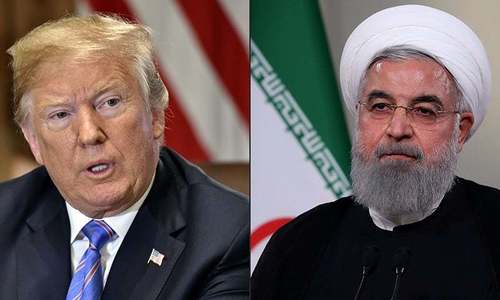
Apply this to the US’ increasing threats to Iran. President Trump’s reality is not mirrored by Iran. Iran knows the US better than Trump knows Iran. Attacking Iran would be like provoking a tiger in an unlocked cage. Trump’s ham-handed ‘coercive diplomacy’ of sanctions against Iran and its Supreme Leader personally is flawed. Iran’s oil will seep through back doors to its clients, just as Iraq’s did during the period of US sanctions against Saddam Hussein. Iraqi oil was then traded with US and UN approval under the euphemism of an ‘Oil-for-Food’ programme.
President Trump has made clear who his enemy is: Iran. Who are his allies in this warm-up to the third world war? Look no further than the group photographs of G20 summits held at Buenos Aires in 2018 and recently at Osaka. In Buenos Aires, Saudi crown prince Mohammad bin Salman stood alone, a pariah after the Khashoggi murder, relegated in the group photograph to the end of the second row. Six months later, in Osaka, Trump placed the Saudi crown prince next to himself, co-primus inter pares. The price for such lethal proximity can be high, as the late Shah of Iran discovered.
President Trump has brought the prospect of a third world war to our doorstep. He is prepared. Iran is. Are we another Muslim nuclear power ready for the fallout?
The writer is an author.
Published in Dawn, July 4th, 2019