India revokes occupied Kashmir's special autonomy through rushed presidential decree


With an indefinite security lockdown in Indian-occupied Kashmir (IoK) and elected representatives under house arrest, India's ruling Bharatiya Janata Party (BJP) stripped Kashmiris of the special autonomy they had for seven decades through a rushed presidential order on Monday.
By repealing Article 370 of the constitution, people from the rest of India will now have the right to acquire property in occupied Kashmir and settle there permanently. Kashmiris as well as critics of India’s Hindu nationalist-led government see the move as an attempt to dilute the demographics of Muslim-majority Kashmir with Hindu settlers.
Article 370 had also limited the power of the Indian parliament to impose laws in the state, apart from matters of defence, foreign affairs and communications.
As India's parliament debated the move, 8,000 Central Reserve Police Force (CRPF) from different parts of the country were moved to IoK. The Indian army and air force were also placed on high alert.
Explainer: What does India's proposed change to occupied Kashmir's status mean?
Home Minister Amit Shah also moved a bill to bifurcate the state into two union territories – Jammu Kashmir as one and Himalayan Ladakh region as the other – directly ruled by New Delhi.
A statement issued by the home minister said that "Jammu and Kashmir will be a union territory with legislature while Ladakh will be a union territory without legislature".
The move raises fears of further violence in the Muslim-majority Himalayan region where Kashmiri fighters and many residents have fought for the region's independence or to join Pakistan.
"There will a very strong reaction in Kashmir. It's already in a state of unrest and this will only make it worse," Wajahat Habibullah, a former senior bureaucrat in Jammu and Kashmir, told AFP.
The constitutional provisions revoked on Monday were introduced decades ago and included reserved government jobs and college placements for residents, in an effort to keep the state from being overrun by people from the rest of India.
Chaos in the house as opposition protests
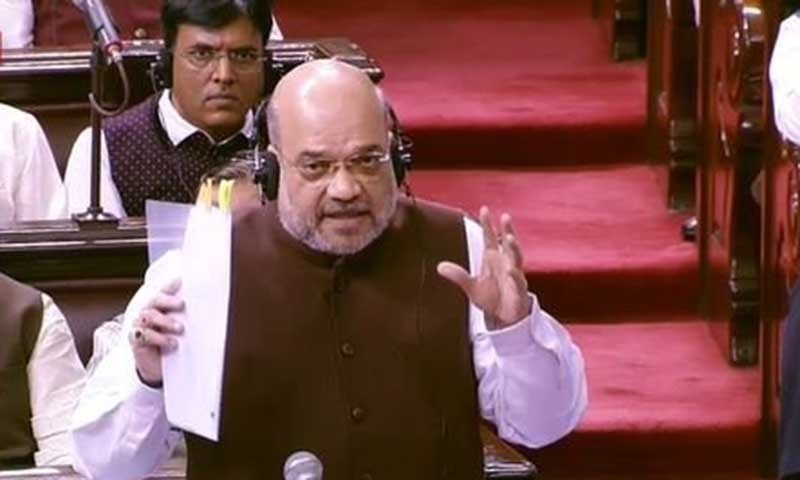
Chaos erupted in the upper house of the Indian parliament as opposition lawmakers shouted slogans and started protesting after Home Minister Amit Shah urged members to discuss the legislation that seeks to end the autonomous status for Muslim-majority Kashmir.
Read: 'Day of shame': Indian opposition slams BJP move to revoke occupied Kashmir's special status
Shah, also the BJP president, proposed that the regulation under Article 370 will not be applicable after presidential nod — a move which was slammed by the opposition.
Leader of the Opposition in the Rajya Sabha Ghulam Nabi Azad said that the BJP had "murdered the constitution today".
Parliamentary affairs minister Pralhad Joshi sought to reprimand the opposition, reported Hindustan Times. “Amit Shah is rectifying the historical blunder of Jawaharlal Nehru,” Joshi told the opposition benches about the resolution that had been on the agenda of the ruling BJP for years.
Amit Shah said Article 370 was used as "vote bank politics" and the earlier governments lacked the political will to revoke it. "But the Modi government has the political will and we are not bothered about vote bank politics," Shah said.
Earlier in the morning, a cabinet meeting was held at Modi's residence.
According to India Today, Indian opposition leaders also met in the parliament on Monday morning to discuss the security situation in Kashmir.
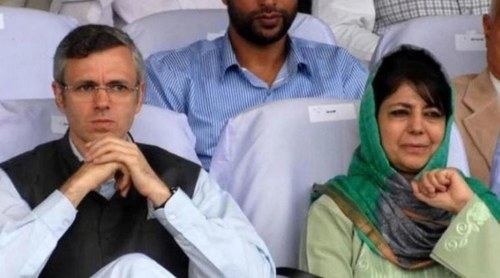
Meanwhile, former Jammu and Kashmir chief minister and PDP chief Mehbooba Mufti and National Conference leader Omar Abdullah were arrested, Times of India reported.
Curfew-like restrictions
Tension had risen in Kashmir since Friday, when Indian officials issued an alert over possible militant attacks. Thousands of alarmed Indian tourists, pilgrims and workers streamed out of the region over the weekend.
Late on Sunday night, the Indian government imposed curfew-like restrictions in the restive region while sending in tens of thousands of additional troops.
Former IoK chief ministers Omar Abdullah and Mehbooba Mufti were placed under house arrest.
Communications were cut, with private mobile networks, internet services and telephone landlines cut, an AFP reporter said.
"There shall be no movement of public. All educational institutions shall also remain closed. There will be a complete bar on holding any kind of public meetings or rallies during the period of operation of this order. Identity cards of essential services officials will be treated as movement passes wherever required," read an Indian government order, but added: "there is no curfew in place".