DUBAI: Around three million barrels per day of Saudi oil will remain offline for a month, about half the production halted by the weekend’s devastating attacks on key crude facilities, S&P Platts said on Tuesday.
The report came as oil prices dipped slightly following record gains Monday as uncertainty prevailed on global markets over when the OPEC kingpin will be able to restore lost production.
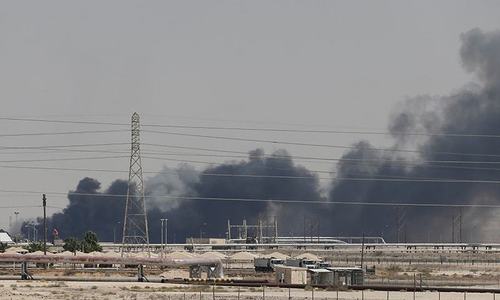
Strikes on Abqaiq — the world’s largest processing plant — and the Khurais oilfield that the US has blamed on Iran have knocked out 5.7 million barrels per day (mbpd), or six percent of global production.
“At this point, it looks likely that around 3.0m bpd of Saudi Arabian crude supply will be offline for at least a month,” S&P Global Platts said in a report.
The Saudi cabinet chaired by King Salman warned on Tuesday the unprecedented attacks posed a threat to global energy supply.
“The goal of the unprecedented destructive aggression... is to target primarily global energy supplies,” the cabinet said in a statement.
“We urge the international community to take firmer measures to stop these flagrant aggressions,” said the statement, cited by the SPA news agency.
The kingdom stressed that it was “capable of responding to the attacks”, regardless of who the perpetrators were, but did not name any.
But it reiterated earlier claims that the strikes were carried out with Iranian weapons.
Challenging
Riyadh pumps some 9.9m bpd of which around 7.0m bpd are exported, mostly to Asian markets.
“Saudi Arabia will likely say that they can fully supply their customers, although as time goes on this may be challenging. Any indication of delays or supply tightness will lead to further price increases in the weeks/months ahead,” S&P said.
The threat of a prolonged supply outage from Saudi Arabia highlights the lack of spare production capacity in the market, estimated at 2.3m bpd, most of it held by Riyadh, the energy news provider said.
Reports said Monday the kingdom was likely to restore up to 40 per cent of the lost production immediately, but experts had conflicting views on how long it will take to bring production back to pre-strike levels.
The crisis revived fears of a conflict in the tinderbox Gulf region and raised questions about the security of crude fields in the world’s top exporter as well as for other producers.
London-based Capital Economics said global crude stocks, estimated at around 6.1 billion barrels, should be able to compensate for the lost output.
It said that if Saudi Arabia manages to restore full production by next week, oil prices would quickly come down to around $60 a barrel.
But if it takes months and tensions persist, benchmark Brent crude prices could hit $85 a barrel, it said.
Oil prices sink
Oil prices sank five per cent on Tuesday, reversing some of the previous day’s gains as analysts predicted Saudi output would recover sooner than expected after weekend drone attacks.
In the space of several minutes in afternoon European trading, North Sea Brent crude oil for delivery in November tumbled from $67.75 to $65.00. It fell as low as $64.24, before recovering somewhat.
The market was already trading in negative territory after the previous day’s record gains that were fuelled by attacks on Saudi facilities which wiped out half the kingdom’s crude output.
“The markets were once again wrong-footed by the Saudi news,” said Forex.com analyst Fawad Razaqzada in reaction to Tuesday’s price drop.
“This time prices slumped on reports of sooner-than-expected return for oil production after the attacks.
“Although little details have emerged, speculators are evidently happy to sell now and ask questions later. And who would blame them after that big (price) gap?”
The spike in the oil price had stoked fears that costlier energy and geopolitical instability could weigh on an already slowing global economy, but a quick recovery in Saudi exports and a return to earlier price levels would alleviate those concerns.
“Arguably Monday’s spike in oil was unsustainable, since oversupply concerns have been the much more dominant theme this year, but the sudden drop came earlier and quicker than expected,” said Chris Beauchamp, chief market analyst at online trading firm IG.
Traders were meanwhile nervously awaiting a further response from the United States after it said Iran was likely to blame.
The crisis revived fears of a conflict in the tinderbox Gulf region and raised questions about the security of crude fields in the world’s top exporter Saudi Arabia as well as other producers.
“Oil’s reversal didn’t do much for the global markets. The indices remain concerned over what happens next between Saudi Arabia and Iran, fears that helped to undermine sentiment,” said Spreadex analyst Connor Campbell.
The attack on Saudi oil facilities also took attention away from the upcoming trade talks between China and the US, as well as a much-anticipated policy meeting of the Federal Reserve, which is expected to cut interest rates Wednesday.
Published in Dawn, September 18th, 2019