ISLAMABAD: The Jamiat Ulema-i-Islam (JUI-F) and the Pakistan Peoples Party (PPP) agree that there is a need for launching a campaign to send the present government packing, but still differ on its modalities.
The leaders of the two parties met here on Wednesday to sort out differences after the PPP refused to participate in next month’s ‘‘long march’’ that the JUI-F has called.
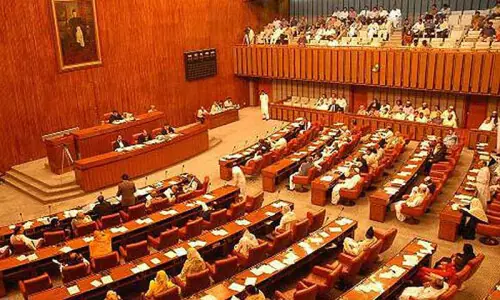
JUI-F leader Akram Durrani, who is also the convener of the opposition’s Rahbar Committee, met PPP leaders Nayyar Bokhari, Sherry Rehman and Faisal Karim Kundi at the Parliament House to discuss the situation.
“There is agreement among the opposition parties that this incompetent government must go. The issue that is yet to be discussed is the modalities of the protest movement,” Mr Bokhari told Dawn after the meeting.
He said PPP chairman Bilawal Bhutto-Zardari had already presented the party’s charter of demand and there seemed to be unanimity of views among all the parties.
Consultations continue to thrash out differences
After attending a party meeting on Sept 18, Mr Bhutto-Zardari had presented six demands, saying the PPP wants to ensure the supremacy of the Constitution and democracy; the upholding of the 18th Constitutional Amendment; reforms in the accountability process to ensure across-the-board accountability; the setting up of a constitutional court in line with the Charter of Democracy signed between the PPP and the PML-N in May 2006; the repeal of 19th Amendment and reforms in Article 184(3) of the Constitution that allows judges to take suo motu action; and the protection of the right of the freedom of speech and press.
Mr Bokhari said they had discussed various proposals regarding the mode of protest against the government and would now brief their respective leaderships.
Earlier, during a brief chat with reporters, Mr Durrani said they had listened to each others’ viewpoint and would meet again after consulting their leaderships. He claimed that there was complete understanding on the charter of demands.
Mr Durrani said the JUI-F and PPP had reached complete consensus on one idea: “We have to send this government home. We have to send this prime minister home.”
However, he said, talks on how this would be achieved would continue.
Sources told Dawn that during the meeting, PPP leaders registered their protest over the JUI-F’s move to unilaterally call the ‘‘long march’’, and that the PPP leaders had asked the JUI-F to postpone the event till December.
The PML-N has also convened a meeting of its central executive committee on Sept 30 to discuss the possibilities of joining the JUI-F’s ‘‘long march’’.
In August, JUI-F chief Maulana Fazlur Rehman announced that his party had planned a “decisive long march” aimed at ousting the present “fake government” in October. He had warned the government against making any effort to disrupt what he called an “Azadi March” to free the country of the present “incompetent and illegitimate government”.
The relationship between the JUI-F and the PPP turned sour after leaders from both parties accused each other of playing politics over the issue.
The PPP is unwilling to participate because of the inclusion of the issues of blasphemy laws and Namoos-i-Risalat on its agenda. Moreover, both the PPP and the PML-N are also opposing the idea of holding an indefinite sit-in, as the PTI did in 2014.
Sources said the JUI-F leadership was unhappy over certain remarks made by PPP chairman Bilawal Bhutto-Zardari. Speaking at a news conference after presiding over a meeting of the party’s core committee in Islamabad on Sept 19, Mr Bhutto-Zardari had ruled out the possibility of joining the ‘‘long march’’.
“I do not want to do the politics of dharna. I want to do the politics of Shaheed Benazir Bhutto. Why do you want me to become a maulvi,” the PPP chairman said in response to a question as to why the party was avoiding the anti-government protest.
Mr Bhutto-Zardari said that he had already announced his party’s “moral support” for the JUI-F’s ‘‘long march’’. He asked how he could believe that the military leadership would not play the same role that it had played during the PNA (Pakistan National Alliance) movement that led to the imposition of martial law in 1977.
Published in Dawn, September 26th, 2019