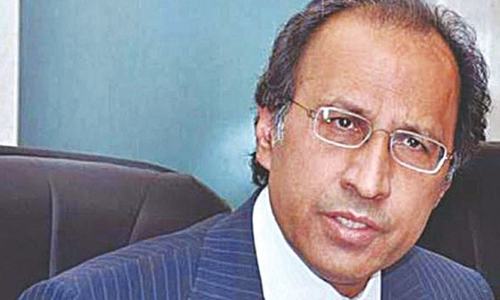
Minister says over 700 ‘terror financing’ cases are near completion


ISLAMABAD: Just days after Pakistan escaped being blacklisted by the Financial Action Task Force (FATF), the government has disclosed that as part of the global watchdog’s action plan, more than 700 under-investigation suspected terror financing cases are near adjudication.
Addressing a news conference on Wednesday, Minister for Economic Affairs Hammad Azhar, who was the chief negotiator on behalf of the country at the Paris-based FATF last week, eulogised the success of his government in dealing with terror financing and money laundering issues. “We have initiated these terror financing cases in the last six months,” he said, claiming that Islamabad’s efforts on that account were highly appreciated at the meeting. But the minister did not elaborate the number of cases nearing “conviction”.
The FATF demand from Pakistan’s executive, according to Mr Azhar, is to investigate cases of terror financing and gather information. “Prosecution and conviction is the domain of the judiciary,” he said, adding that he did not want to comment on it as the “judiciary is independent” in Pakistan. “The ball is now in the judiciary’s court,” he said.
The minister, however, believed the government would improve its prosecution in the coming days.
He set June 2020 as an indicative target for compliance with all 27 actions plan to come out of the grey list. Pakistan will submit its report to the International Cooperation Review Group (ICRG) of the FATF in January 2020, which will include all actions being taken since September 2019.
The minister said that on average the countries placed on grey list took two and a half years to three years to come out of grey list.
On the issue of proscribed outfits, the minister said they would be dealt according to the national laws. But there was a need for strengthening investigation and prosecution, he added. “We are working on improving further inter-agency coordination to improve compliance,” he said.
The minister said that more than 64,000 non-profit organisations had been mapped so far.
Flanked by head of the Financial Monitoring Unit (FMU) Mansoor Siddiqui, the minister said investigations were carried out on the basis of suspicious transactions that the FMU had received from different banks.
“More than 60pc of the suspicious transactions reports have been translated into intelligence reports,” he said, adding the reports became the primary source of investigation into terror financing. He said the reports gradually turned into conviction, he said, without disclosing the data of convictions.
Perhaps Pakistan is the only country going through two monitoring processes of the FATF — one by its regional group, Asia Pacific Group (APG), and the other by the International Cooperation Review Group (ICRG) of the task force. The APG has made 40 recommendations to Pakistan, while the ICRG has suggested 27 action plan for compliance.
At the same time, the compliance bench mark set for Pakistan is tougher than other countries. The minister said it was mainly due to the nature of high risks of terror financing in Pakistan. “This is challenging and ambitious because our compliance level is tough compared to other countries,” he said, adding that compliance to all these recommendations would help Pakistan to mitigate risks.
Mr Azhar said the government was committed to complete compliance to ICRG action plan by June 2020. He said difficult actions were placed on the ICRG plan, while the recommendations of the APG were not difficult to comply with as Pakistan position as observer will remain till October 2020.
“Our priority is ICRG action plan,” though both the monitoring processes would go parallel, he said, while expressing the hope that Pakistan’s position on APG recommendations would improve in the next mutual evaluation report from the last one that came in October 2018.
In case the compliance to APG recommendations is not up to the mark, Pakistan can still get up to three years for implementation of the action plan suggested by the APG. He made it clear Pakistan position would improve when the past year data would be considered in the next report of APG.
The minister said one of the biggest achievements of Pakistan at the recent meeting at the FATF was that Islamabad blocked attempt of some ‘circles’ wanted to merge recommendations of the APG and the ICRG of the FATF, which could have made the situation quite difficult for Pakistan as the action items could have exceeded over 100.
“It was not logical, nor feasible for Pakistan,” he said, adding it had been decided that the country would get the whole period of APG for compliance that, too, was a success for Pakistan.
The minister did not disclose the names of other countries but said it was ironic that India had overplayed its role while using an international technical forum for political purposes. “We will not let any country to use such forums for getting political mileage,” the minister said.
Mr Hammad said Pakistan’s position on terror and money laundering risks had been upgraded. Elaborating further steps, he said inter-agency coordination had been established, risk-based supervisory framework was in place while risk-based investigation strategy had been prepared for law enforcement agencies. “Now it is time for implementation of all these measures,” he said.
Led by the minister for economic affairs, an FATF coordination committee has been constituted and an FATF secretariat established with.
The minister said the caretaker government had agreed on the implementation of 27 action plan of the ICRG in a period of 15 months. “We have done significant progress in implementing most of these action plans,” he said, adding further progress would be visible within the next few months.
However, the minister admitted that proceedings at the FATF were confidential. “We have to keep the confidentiality of the FATF,” he said, adding discussion in the FATF was mainly based on the technical reports.
Published in Dawn, October 24th, 2019