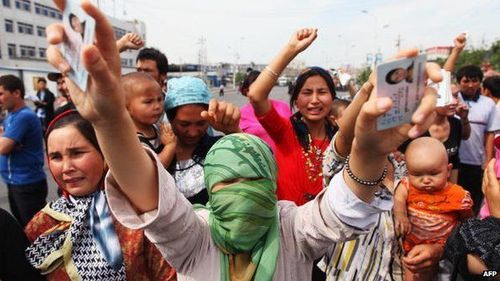
IMAGINE a scenario in which a Western country locks up hundreds of thousands of Muslims in internment camps. Here, they are ‘re-educated’ to adopt liberal values that include a change of language and lifestyle.
Had such a deliberate effort to brainwash an entire Muslim community been attempted, there would be riots and protests across the Islamic world. Embassies of the country responsible for this outrage would be attacked, and its businesses boycotted. We know from experience that this sequence of events is pretty much standard operating procedure whenever real or perceived acts of state-organised violence against Muslims take place.
Also read: In China's Xinjiang, Big Brother moves into Uighur homes as 'family'
So why the deafening silence across the Islamic world when around 1.5 million Muslims in China’s Xinjiang province have been forced into vast ‘re-education centres’? Even before this policy was launched, Uighur culture was under attack, with beards and headscarves strongly discouraged by an increasingly harsh Chinese administration. It is now virtually impossible to find books in the Uighur language in bookshops.
Around half the province’s population of 24m is Sunni, and largely follows the Sufi tradition. Apart from Uighurs, there are Kazakhs, Kyrgyz, Hui and other minorities in Xinjiang. Ever since the government in Beijing began its policy of moving Han Chinese to the province to dilute the Muslim presence, Uighur separatist groups have resisted and staged sporadic attacks. As often happens, the state has countered with tough action and policies.
The ummah’s response to the Uighurs’ plight is puzzling.
The aim of the Chinese government is to ‘transform through education’. For thousands of years, the Chinese ruling class has sought to build a stable society free of tension between various ethnic groups. So when a handful of Uighur resisted the attempt to integrate them into mainstream Han culture, they were accused of separatism and subversion. One such group is the Uighur mother-tongue movement: the authorities have dubbed it the ‘fourth evil’ after separatism, religious extremism and terrorism.
One example of China’s historic policy of standardising rules across the country is that despite spanning five time zones, it only has a single standard Beijing time. This leads to anomalies such as Kashgar in the west having to follow the same time as the capital. So the sun can be shining while the clock shows 9 pm.
While the policy of brainwashing the Uighur has been widely criticised in the west as ‘cultural genocide’, Muslims have been largely silent. One reason for this hypocritical approach is the clout China wields. For Pakistan, China has been the bedrock of our foreign policy, as well as our economic saviour. It is also an important importer of Saudi and Iranian oil. And other developing Muslim countries have benefited from Chinese aid and loans. All these factors have served to mute criticism of Beijing’s assault on Uighur religion and culture.
But just as important is the pivotal role Xinjiang is expected to play in China’s Belt and Road Initiative. Roads and railway lines from various points around the world will carry thousands of containers, and China is nervous about any disruption caused by separatist groups. It has already seen how such terrorism can affect infrastructure projects in Balochistan.
China denies that it is trying to brainwash the Muslim population of Xinjiang, but government spokesmen have admitted to a policy of training and educating the young. In many cases, children have been separated from parents to be placed in these centres where they are indoctrinated and forced to learn Mandarin Chinese. More and more, a single, monolithic Han culture is being forced on minorities. Muslims, in particular, are at the sharp end of this policy.
Xinjiang means ‘new frontier’, and was given this name when the vast region was conquered by the Qing dynasty in the 18th century after a series of bloody battles. However, this conquest was resisted by warlords who regained control of various areas from time to time. In fact, for a short time, they set up the Republic of East Turkestan.
Since then, there has been friction between Urumqi, the capital of Xinjiang, and Beijing. And as the stakes have risen, so has the level of repression. Electronic surveillance has been a key element in this crackdown. Locals have been forced to hand over mobile phones so that their sim cards can be read by the police. Security forces at innumerable check posts stop and search locals and foreigners alike, and CCTV cameras check their photographs against a central databank.
The victims of these human rights violations have no right of appeal. China is a one-party dictatorship. In its long history, there hasn’t been a single period when democracy was practised. To a large extent, people accept a strong central government that has lifted hundreds of millions out of poverty in a single generation.
But the attitude of the ummah is surprising: both on the left and right, Muslims have been like the proverbial ostriches.
Published in Dawn, October 26th, 2019