Thousands trapped on Australia beaches encircled by fire


Thousands of holidaymakers and locals were forced to flee to beaches in fire-ravaged southeast Australia on Tuesday, as blazes ripped through popular tourist areas leaving no escape by land.
Four thousand people were trapped on the foreshore of the town of Mallacoota and many others sought refuge on beaches in fire-encircled seaside towns up and down a 200-kilometre (135-mile) strip of coast.
Some residents with boats even took to the sea, hoping for refuge from one the worst days yet in Australia's months-long bushfire crisis.
Dozens of properties were feared to have been destroyed since late Monday and at least seven people were unaccounted for in New South Wales and Victoria states as flames reached well-populated towns like Batemans Bay.
In some places the blazes were so intense, the smoke so thick and the fire-provoked dry lightning storms so severe that aerial reconnaissance and waterbombing had to be halted, the New South Wales Rural Fire Service said.
In Mallacoota, smoke turned day to night and the authorities said nearby fires were causing extreme thunderstorms and "ember attacks".
"We've got a fire that looks like it's about to impact on Mallacoota," Victoria's Emergency Management Commissioner Andrew Crisp told public broadcaster ABC, adding that firefighters had been deployed to protect the group.
Authorities had for days been warning tens of thousands of tourists enjoying Australia's summer holidays to leave the area but for thousands it was now too late to leave.
"We've got three strike teams in Mallacoota that will be looking after 4,000 people down on the beach there," Crisp said.
"We're naturally very concerned about communities that have become isolated."
Preparations were reportedly under way for an evacuation by sea or air if needed.
On social media, residents said they fled on boat or were putting on life jackets in case they need to seek refuge from the fire in the water.
'Last resort'
Temperatures in bushfire areas can hit hundreds of degrees Celsius (Fahrenheit) killing anyone nearby long before the flames reach them.
Fleeing into the ocean is a "last resort option" according to Victoria's emergency management agency.
Local radio journalist Francesca Winterson said she was watching the fire approach the town and her own home while she tried to broadcast emergency warnings amid a powercut.
"I'd rather be alive than have a house," she told ABC Gippsland.
Australia's unprecedented bushfires have been burning for months, but the latest in a series of heatwaves and high winds have wrought new devastation.
The crisis has hit cities like Sydney and Melbourne, home to several million people.
On Monday, around 100,000 people were urged to flee five Melbourne suburbs as the spiralling bushfire crisis killed a volunteer firefighter battling a separate blaze in the countryside.
Authorities in the country's second-biggest city downgraded an earlier bushfire emergency warning but said residents should steer clear of the blaze, which has burned through 40 hectares (nearly 100 acres) of grassland.
Local media showed images of water bombers flying over neighbourhoods, and families hosing down their homes in the hope of halting the fire's spread.
A volunteer firefighter died in New South Wales state and two others suffered burns while working on a blaze more than five hours southwest of Sydney, the Rural Fire Service said.
"It's believed that the truck rolled when hit by extreme winds," the agency said, adding that the man left behind a pregnant wife.
Ten others, including two volunteer firefighters, have been killed so far this fire season.
The blazes have destroyed more than 1,000 homes and scorched more than three million hectares (7.4 million acres) — an area bigger than Belgium.
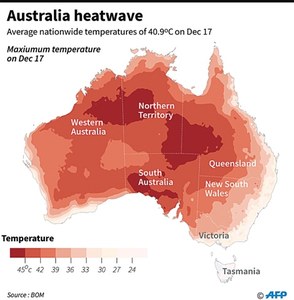
The mercury reached 47 degrees Celsius (117 Fahrenheit) in Western Australia and topped 40 degrees in every region — including the usually temperate island of Tasmania.
The crisis has focused attention on climate change — which scientists say is creating a longer and more intense bushfire season — and sparked street protests calling for immediate action to tackle global warming.
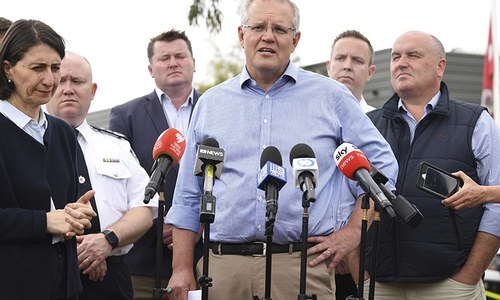
While conservative Prime Minister Scott Morrison belatedly acknowledged a link between the fires and climate change, he has continued his staunch support of Australia's lucrative coal mining industry and ruled out further action to reduce emissions.
Sydney was again shrouded in toxic bushfire haze on Tuesday. City officials said Sydney's New Year's Eve fireworks would go ahead, but a similar event has been cancelled in Canberra and several regional towns.