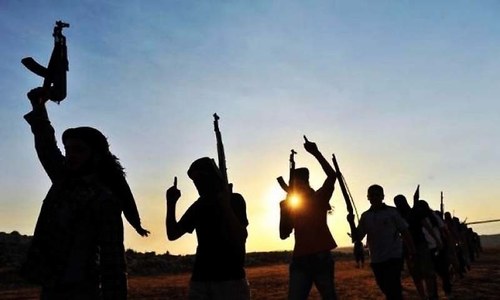
Terror attacks drop but Pakistan 'not out of the woods' yet


Terror attacks in Pakistan plummeted by more than 85 per cent over the last decade. It's a welcome statistic for the country, but one that risks being overshadowed by international concern over its efforts to curb terror funding and lingering militant activity that could test any future peace agreement in neighbouring Afghanistan.
The tally, put together by Pakistani think tanks, found terror attacks dropped from nearly 2,000 in 2009 to fewer than 250 in 2019, a steady decline that underscores the long-haul nature of fighting terror.
But Paris-based international watchdog Financial Action Task Force (FATF) said in October that Pakistan was not doing enough to stop terror financing. The group meets next month to decide whether the country should be downgraded from a grey status to black, alongside Iran and North Korea, a step that could pose a challenge to the country's economy.
Pakistan's militant groups are often interlinked with those across the border in Afghanistan, so its progress at reining in terror is critical, particularly as Washington seeks to secure a deal with the Afghan Taliban to bring an end to the 18-year war, America's longest military engagement.
"The sharp decrease in terrorist violence, which we began to see in 2014, is nothing short of remarkable," said Michael Kugelman, Asia Program Deputy Director at the Washington-based Wilson Center. But, he cautioned, Pakistan is certainly "not out of the woods" yet.
Last year, FATF, the watchdog that monitors terror financing, said Pakistan had fully implemented only one item from a list of 40 measures to curb terror financing and money laundering. The other 39 measures were either partially implemented or, in some cases, overlooked entirely.
Pakistan, however, has insisted time and again that it has made significant progress in most of the areas highlighted by the FATF. Earlier this week, State Bank of Pakistan (SBP) Governor Dr Reza Baqir said that the last two reviews in May and September showed that Pakistan had made significant progress in most of the 27 points raised by the FATF.
If Pakistan is blacklisted, every financial transaction would be closely scrutinised, and doing business with the country would become costly and cumbersome. Pakistani officials say they are working to meet the task force's demands and expect to avoid a blacklisting at the crucial meeting in Paris in February.
Earlier this month, Pakistan's economic affairs minister held a preliminary meeting with a FATF regional affiliate to make a case for removal from the so-called 'grey list'.
Pakistan's military and intelligence have long been accused by Washington, as well as by Pakistan's neighbours, of supporting some militants while attacking others — a charge denied by both. Over the last two decades, successive American administrations have pressed Islamabad to crack down on terror. Pakistan points to its more than 4,000 military casualties since the 2001 start of the so-called war on terror higher than the United States and Nato deaths combined as proof of its commitment.
Prime Minister Imran Khan has also consistently pointed to the loss of Pakistani lives during the war and the toll it took on the country's economy.
Over the past decade, Pakistan has been accused of being home to a large array of militant groups.
Since early last year, Pakistan has banned 66 organisations declared as terrorist or terrorist-supporting groups and listed an estimated 7,600 individuals under its anti-terrorism act.
In a surprisingly tough ruling, a court last week handed jail sentences of more than 55 years to dozens of extremists belonging to Tehreek-i-Labbaik Pakistan (TLP) who destroyed cars and storefronts protesting the acquittal of a Christian woman, Asia Bibi, on blasphemy charges.
Prime Minister Imran promised zero tolerance for extremists after several attacked a Sikh shrine earlier this month in southern Punjab province.
Yet, extremist groups and ideologies can still operate in Pakistan. "Radicalisation and terrorism remain very real threats, even if the main perpetrators of terror have become shadows of their former selves," Kugelman said.
Amir Rana, executive director of the Islamabad-based Pakistan Institute for Peace Studies, one of the groups which released a report on the decreasing attacks, said the decline was indicative of the long-haul nature of fighting terror and those who perpetrate it. He said it involves years of surveillance, military counterterrorism offensives and a counterterrorism strategy that seeks to identify and curb funding.
Still, Pakistan has a way to go in making the institutional changes necessary to curb terror financing and the militant groups still operating, Rana said. Less than 1pc of Pakistanis pay taxes, revenues are routinely undocumented and the so-called hawala system of informally sending money around the globe still flourishes, all of which bedevils efforts to curtail terror financing.
Pakistan's success in tackling terror is essential amid American attempts to wind down the war in Afghanistan and withdraw US troops.
President Donald Trump has repeatedly expressed a desire to bring home the roughly 13,000 US soldiers still in Afghanistan and last November gave his peace envoy, Zalmay Khalilzad, the go-ahead to resume talks with the Afghan Taliban.
Last week, the insurgent group handed Khalilzad a seven-10-day ceasefire offer, which could pave the way for American troops to withdraw and jumpstart peace negotiations between Afghans on both sides of the conflict.
Khalilzad said previously that any agreement will require the Afghan Taliban to abandon terror groups like Al Qaeda with which they have longstanding ties that some analysts say could prove difficult to sever.