Pakistan reiterates backing for US efforts for Afghan peace


ISLAMABAD: Amidst renewed diplomatic efforts for the implementation of the US-Taliban agreement, Pakistan on Tuesday reiterated its backing for the American efforts for a negotiated settlement of the 19-year-old conflict in Afghanistan.
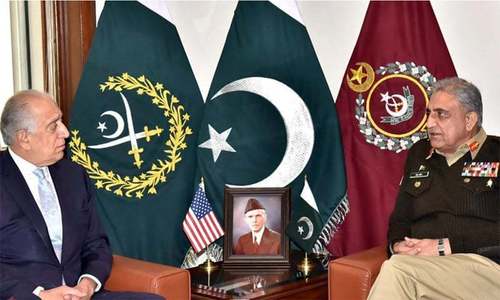
“Pakistan’s military leaders reaffirmed their support for US efforts and renewed their commitment to act to advance a political settlement to the conflict,” US embassy said in a statement after a short visit by the Special Representative for Afghanistan Reconciliation Amb Zalmay Khalilzad and Resolute Support Mission Commander Gen Austin Scott Miller to Rawalpindi.
The embassy said that the two met Army Chief Gen Qamar Bajwa for a discussion on the US efforts for peace in Afghanistan.
According to Inter Services Public Relations (ISPR), the visiting US officials and the army chief discussed “matters of mutual interest, overall regional security situation, including Afghan refugees issue and Afghan reconciliation process”.
Gen Bajwa emphasised that amidst the situation arising out of Covid-19, they should not lose the hard-earned gains made in terms of the Afghan Peace Process and peace and stability in the region.
Special envoy Khalilzad, Gen Miller call on Gen Bajwa
He also updated the visitors on Pakistan government’s efforts for peace and the prime minister’s call for the international community to help alleviate the problems confronting the developing world in the present circumstances, said ISPR.
The visit took place as the US stepped up its efforts for the implementation of its Feb 29 agreement with Taliban.
The agreement was touted as the best opportunity for ending the war in Afghanistan that has cost lives of nearly 150,000 Afghans and over 2,400 American soldiers in addition to colossal economic cost of $975 billion.
The implementation of the accord, however, ran into problems soon after its signing because of differences between Kabul and the Taliban over the release of detainees, which was a key requirement for the start of intra-Afghan negotiations, and continuing violence in Afghanistan.
The Khalilzad-Miller duo had on Monday met Taliban’s chief negotiator Mullah Baradar in Doha, where the insurgent group’s political office is based.
Spokesman for Taliban’s political office Suhail Shaheen said that the meeting was hosted by Qatari Foreign Minister Sheikh Mohammad bin Abdur Rahman Al-Thani. “They talked about complete implementation of the agreement as well as delay in the release of the prisoners. Violations of the agreement and other issues and ways of their solutions were also discussed,” Shaheen said.
Gen Miller had earlier met the Taliban leaders in Doha on Friday as well for discussing reduction in violence. The insurgent group had after the meeting with Gen Miller released the first batch of 20 detainees. The detainees were handed over by the Taliban to the Red Cross in Kandahar. This was seen as a major step for taking the peace agreement forward.
The Afghan government has, meanwhile, set free 300 Taliban prisoners over the past few days. The prisoners, the Taliban say, have been conditionally released by Kabul against its earlier commitment of unconditionally freeing the insurgent detainees.
Under the February 29 agreement, the Afghan government had to set free 5,000 Taliban prisoners, whereas the Taliban were to release 1,000 captives by March 10 for the start of intra-Afghan negotiations. The delay in the swap has prevented the intra-Afghan talks from beginning.
Foreign Office Spokesperson Aisha Farooqui had at her last weekly media briefing on Thursday said: “We believe that the signing of the US-Taliban Peace Agreement has created a historic opportunity for the people of Afghanistan. It is imperative that this historic opportunity is seized and all parties work together constructively for securing durable peace and stability in Afghanistan.”
Published in Dawn, April 15th, 2020