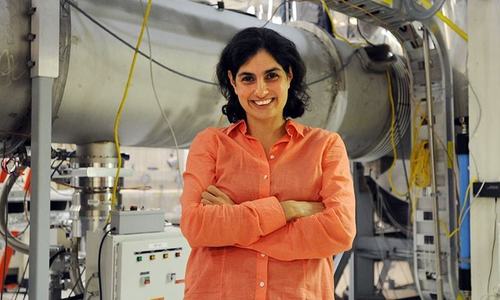
RECENTLY, Pakistan-origin quantum astrophysicist Dr Nergis Mavalvala was named the new dean of the MIT School of Science. A remarkable achievement by the physicist known for her ground-breaking work in gravitational-wave detection, many Pakistanis unreservedly took pride in the news.
But while Dr Mavalvala received her early education in Pakistan, she and several others like her reached the high positions they did through their own efforts and opportunities presented to them in other countries. Unfortunately, Pakistan has done little to invest in the sciences or to promote scientific thinking.
So while we celebrate Dr Mavalvala’s achievements, we must ask ourselves: had Dr Mavalvala continued to study and work in Pakistan, would she have been able to reach the position she is in today? Would she have the space or resources to carry out her breakthrough scientific work here? And would her talent have been recognised by either the government or the society she lived in? Or would we have fixated on her identity, focusing on who she is, rather than what she can achieve, thus propping up barriers to her success?
Consider the genius and tragedy of one of Pakistan’s greatest minds. Born to a family of modest means in Jhang, Dr Abdus Salam credited the local college he attended for laying the foundations of his academic career, and remained grateful to his teachers for sparking his intellectual curiosity.
In 1951, he rejected an opportunity to attend Princeton, so he could secure a teaching job at Government College Lahore. Instead of recognising his potential, though, he was made a football coach at the institute — the first of many heartbreaks he faced in the newly formed country.
Like Dr Mavalvala, he belonged to a religious minority community. In 1979, Dr Salam won the Nobel Prize in physics for his work on the electroweak unification theory that implies the existence of the ‘God particle’ which was subsequently discovered at CERN in 2012. Whether his brilliance was ever truly understood and celebrated in his home country is debatable, and that is Pakistan’s tragedy.
Published in Dawn, August 20th, 2020