CPEC aimed at decreasing China’s reliance on strategic chokeholds: Pentagon


WASHINGTON: Under its One Belt, One Road (OBOR) policy, China is pursuing projects in Pakistan that would decrease Beijing’s reliance on strategic choke points, says a Pentagon report released on Wednesday.
The 2020 Pentagon report on China’s military power also shows that the People’s Liberation Army (PLA) has surpassed the US military in terms of navy size, land-based missiles and advanced air defence systems.
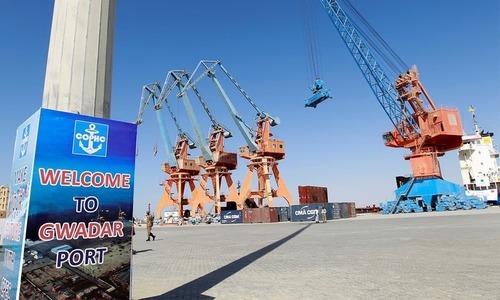
A chapter on Beijing’s economic policies notes that the China-Pakistan Economic Corridor (CPEC) projects focus on pipelines and port construction that would “decrease China’s reliance on transporting energy resources through strategic choke points, such as the Strait of Malacca”.
Launched in 2013, OBOR seeks to foster closer economic integration with countries along China’s periphery and beyond, thereby shaping these countries’ interests to align with Beijing’s, the report adds.
The report notes that OBOR also seeks to promote regional stability to repel criticism over China’s approach to issues it views as sensitive.
The Pentagon argues that the growth of China’s global economic footprint also makes its interests increasingly vulnerable to domestic political transitions in participating countries.
In 2019, Beijing hosted the Second Belt and Road Forum to address growing international scepticism over corruption, indebtedness, environmental sustainability, and lack of transparency over OBOR projects.
Another chapter on China’s foreign policy notes that tensions between China and India persist along the northeastern border in Arunachal Pradesh and near the Aksai Chin region at the western end of the Tibetan Plateau.
Chinese and Indian patrols regularly encounter one another along the disputed border, and both sides often accuse one another of border incursions.
Yet, “Chinese and Indian forces have regularly interacted since the 2017 Doklam standoff and generally kept disputes from escalating in 2019”, the report adds.
The report also notes that despite low-level face-offs among troops, both sides have prevented these incidents from escalating to the level of the 73-day border standoff at the Doklam Plateau in 2017.
Chinese and Indian officials also have continued diplomatic discussion on border issues, the Pentagon adds.
The report acknowledges that in its millennial report two decades ago, the Pentagon largely dismissed the PLA’s rise, yet it is now on track to become a “world-class military” before the middle of this century.
The report claims that China is also attempting to at least double the number of nuclear warheads in its arsenal in the next decade.
The Pentagon calculates that “Beijing will seek to develop a military by mid-century that is equal — or in some cases superior — to the US military, or that of any other great power that China views as a threat”.
Published in Dawn, September 3rd, 2020