'Friends not masters': FM Qureshi assures Afghanistan of complete support for peace process


Foreign Minister Shah Mahmood Qureshi on Tuesday assured Afghanistan of Pakistan's complete support for the Afghan peace process, stating that Islamabad wanted to be "friends not masters".
The foreign minister was speaking at a conference at the Institute of Strategic Studies in Islamabad alongside the chairman of Afghanistan's High Council for National Reconciliation Dr Abdullah Abdullah. The Afghan leader is currently in the capital on a three-day official visit.
Read: Afghan reconciliation leader thanks Pakistan for facilitating peace process
"Security and stability is what we need and our security and stability is interlinked. I want to give a clear message: We have no favourites [and] do not want to meddle in your internal affairs. We respect and want to respect your sovereignty, your independence and your territorial integrity.
"My message [to the people of Afghanistan] is that whatever consensus evolves through your dialogue and negotiations, we will accept it [...] that is the way it ought to be."
Quoting the name of the book by former president Ayub Khan, FM Qureshi said that it was important for Pakistan to be "friends not masters" of Afghanistan.
"That's the paradigm shift and the new realisation and recognition if we have to coexist in peace and build a common future," he said, concluding his address by assuring the Afghan leader and the high-level delegation comprising prominent members of the council of Pakistan's complete support.
During his speech, the foreign minister reiterated that a political settlement was the only solution for the solving the Afghan conflict.
"A realisation has evolved over the years that there is no military solution to the Afghan conflict. Today there is recognition that a negotiated political settlement is perhaps the only and the best way forward."
Warning of "spoilers", he added that an overwhelming majority of Afghans want peace. "There will always be spoilers [...] but the overwhelming majority feels that this is the right way forward and that is a positive development. We feel, and I believe, that only Afghans can decide the future of Afghanistan.
"Sustainable peace can only come from within Afghanistan, it can't be imposed."
The foreign minister also emphasised the need for greater collaboration between the two countries in different fields in order to build a common future.
He said that peace was essential for promoting trade and investment between the two countries. "The moment we have cooperated, we have benefitted. [Therefore] a relationship of cooperation and understanding is the only way forward.
"I realise that the road ahead will be bumpy and it won't be easy. And let's not fool ourselves, it won't be handed to us on a platter. One will have to work for it," he said.
'Pakistan played vital role in facilitating peace process'
In his address, the Afghan leader highlighted that Pakistan had played a vital role in facilitating the Afghan peace process. He added that both the countries have paid a heavy price by facing terror groups that are still acting as "spoilers".
According to Radio Pakistan, Abdullah stated that Afghanistan would not allow any terror entity to pose a threat to any other nation.
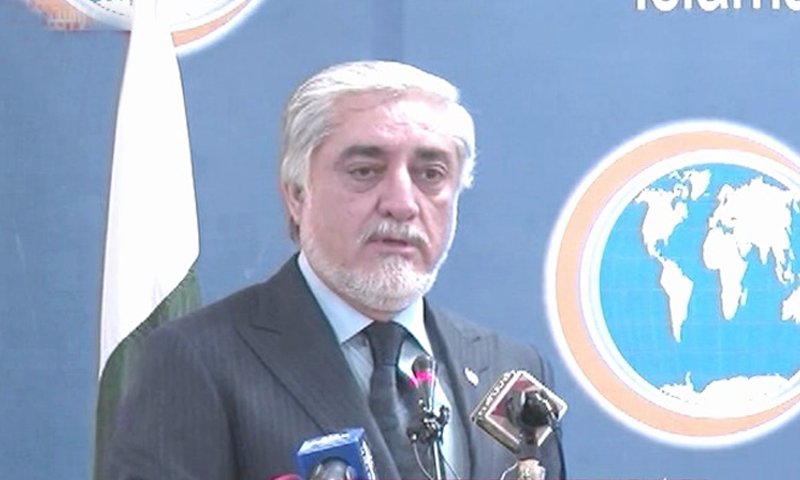
He also recognised the start of negotiations between the Afghan government and the Taliban as an important opportunity, saying that it offered the "best hope to put the war behind us". He said they had asked the negotiating team to be patient and ready to make compromises, the report added.
The Afghan leader highlighted that Pakistan and Afghanistan face common threats and challenges, including terrorism, extremism, intolerance and, more recently, Covid-19. Abdullah said that there was untapped potential for cooperation between the two countries.
He also thanked Pakistan for hosting million of Afghan refugees, adding that Kabul shared Islamabad's view regarding their dignified return.