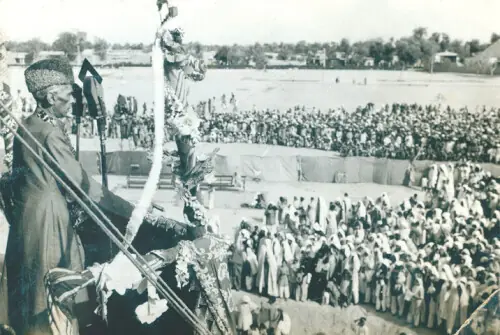
THE Quaid-i-Azam was an ardent supporter of a Palestinian state. When Israel’s first prime minister, David Ben Gurion, sent a telegram in 1947 to Jinnah, requesting him to establish diplomatic relations, that telegram remained unanswered because granting recognition to a Jewish state without establishing an independent homeland for Palestinians was unacceptable to him, and his deteriorating health prevented him to make such a critical decision.
The mystery of Pakistan-Israel relations needs to be examined in some detail in the light of the reality that both the countries were established on the basis of religion more or less at the same time. Both countries fought several wars in order to protect themselves from external threats.
As stated by Syed Sharifuddin Pirzada in Pakistan Horizon (Vo. 29, No. 4, 1976): “On October 12, 1945, Jinnah said every man and woman of the Muslim world will die before Jewry seizes Jerusalem. I hope the Jews will not succeed in their nefarious designs and I wish Britain and America should keep their hands off and then I will see how the Jews conquer Jerusalem. The Jews, over half-a-million, have already been accommodated in Jerusalem against the wishes of the people. May I know which other country has accommodated them? If domination and exploitation are carried now, there will be no peace and end of wars.”
Since Jinnah articulated the position so clearly, Pakistan has pursued a consistent policy on the matter of diplomatic recognition for Israel, but from time to time there has been some hint of mending fences between the two ideologically formed states.
Based on psychological, religious, emotional and political reasons, it will be difficult for any Pakistani regime to grant recognition to Israel. A counter-narrative to the existing Pakistani position is based on the premise that when overwhelming majority of UN members and majority of Muslim countries have granted recognition to the Jewish state, there is a reason for Islamabad to rethink. This school of thought believes that Pakistan can benefit a lot from Israeli excellence in economic, agricultural and technological progress. One can also think of neutralising Indo-Israeli nexus which is detrimental to the security of Pakistan. But Prime Minister Imran Khan was very clear in a recent interview when he stated: “Our policy on Israel is clear. The Quaid-i-Azam had said that Pakistan can never accept state of Israel until the people of Palestine get rights and an independent state.” This, indeed, is the correct position.
(The writer is Meritorious Professor of International Relations and former Dean Faculty of Social Sciences, University of Karachi. E. Mail: amoonis@hotmail.com).