

IOK police charge army officer with killing three labourers in staged gunfight
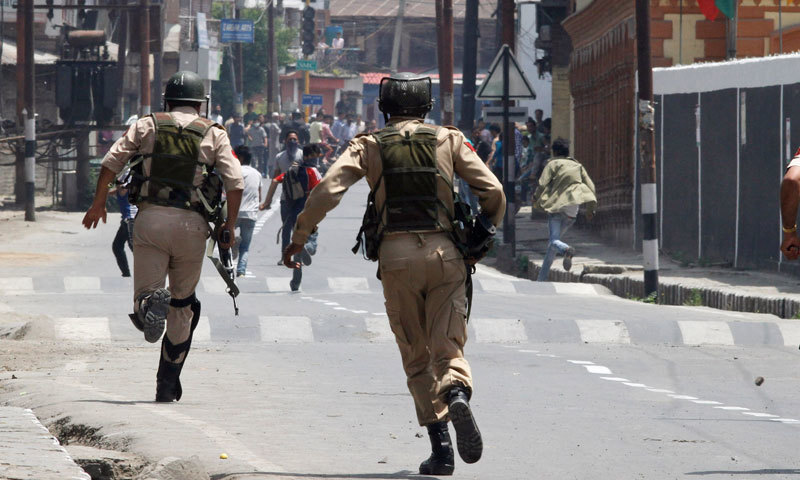

Police in Indian-occupied Kashmir (IOK) on Saturday charged a captain of the Indian army and his two accomplices for killing three local labourers and passing them as militants.
In a charge sheet filed in a local court, police said the captain had staged a gunfight in South Kashmir on July 8 to make it appear like a clash with militants.
A special investigation team of Jammu and Kashmir Police, which was tasked to probe the fake encounter, filed a 300-page charge sheet against the army officer.
Wajahat Hussian, deputy superintendent of police who headed the probe committee, was quoted by local media as saying that the charge sheet has been filed against three persons in the Principal and Sessions Court Shopain area in South Kashmir.
He identified the accused as Capitan Bhupinder of 62 Rashtriya Rifles and Tabish Ahmad and Bilal Ahmad, residents of South Kashmir's Shopain and Pulwama districts respectively.
On Thursday, the army had said that the process of summary of evidence has been completed about the fake encounter in which three labourers of Rajouri district of Jammu region were killed.
The army added that the authorities concerned, along with legal advisers, are examining the case for further proceedings.
Earlier, the family had identified the deceased men as Imtiyaz Ahmad, 21, Abrar Ahmad, 25, and Abrar Khatana, 18, from photos that circulated on social media after the gunfight.
Seventy days later, the bodies of the slain young men were handed to their families after DNA samples matched with their kin.
Indian army probe
On Sept 18, the Indian military admitted wrongdoing and said its internal probe identified the three men killed as local residents, without explaining how the military had identified them. It also said an army investigation showed the soldiers had exceeded the powers granted to them under the Armed Forces Special Powers Act.
Pakistan had subsequently called for a judicial inquiry into the killings, terming the Indian army's statement an "acknowledgement that Indian occupation forces are guilty of war crimes in IIOJK (Indian Illegally Occupied Jammu and Kashmir)".
The Armed Forces Special Powers Act gives the Indian military in Occupied Kashmir sweeping powers to search, seize and even shoot suspects on sight without fear of prosecution. Under the Act, local authorities need federal approval to prosecute army or paramilitary soldiers in civilian courts.
The special powers were given to the military in 1990, a year after an armed rebellion erupted in Occupied Kashmir seeking the Himalayan region’s independence or merger with Pakistan. Kashmiri civilians and activists for years have accused Indian troops of abusing their powers and repeatedly targeting civilians.
In 2000, the Indian army killed five men it alleged were militants responsible for the massacre of 35 Sikhs in the disputed territories. An investigation later found the five were local villagers killed in a faked firefight.
In 2010, a massive uprising erupted in Occupied Kashmir after a police investigation found Indian soldiers had killed three civilians in a staged gun battle and then said the victims were militants in order to claim a reward for killing them. The army responded by suspending two officers.
India has rejected every request since 1989 to prosecute Indian soldiers in civilian courts for alleged human rights abuses including murder and rape, according to official documents.
Meanwhile, on Saturday, two militants were killed and two Indian soldiers injured in a gunfight in the Kanigam village of Shopain.
Disputed region
The Himalayan region has been at the heart of tensions between Hindu-majority India and Muslim Pakistan for decades, the cause of two of the three wars between the nuclear-armed neighbours. Both countries claim the region in full, but each rules only in part.
On Aug 5, 2019, Indian Prime Minister Narendra Modi split the state of occupied Jammu and Kashmir into two federally controlled territories and took away its special privileges, claiming this was necessary to better integrate the region with the rest of India.
New Delhi flooded troops into the Muslim-majority valley, where armed Kashmiris have struggled since the 1990s. India detained thousands, imposed harsh movement restrictions and forced a communications blackout.
Many of those measures have since been eased, but the internet remains throttled and a subsequent Covid-19 lockdown has forced millions of Kashmiris to stay in their homes since.
Earlier this week, a multi-party coalition that opposed India's unilateral decision won the region's district council elections.




























