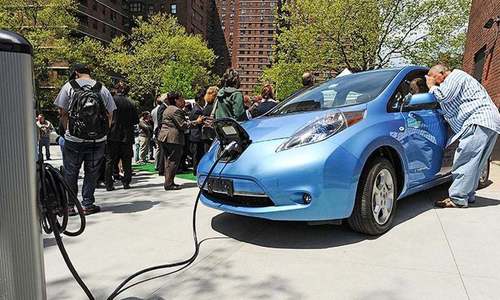
Israeli 5-minute battery charge aims to fire up electric cars


From flat battery to full charge in just five minutes — an Israeli start-up has developed technology it says could eliminate the “range anxiety” associated with electric cars.
Ultra-fast recharge specialists StoreDot have developed a first-generation lithium-ion battery that can rival the filling time of a standard car at the pump.
“We are changing the entire experience of the driver, the problem of 'range anxiety' [...] that you might get stuck on the highway without energy,” StoreDot founder Doron Myersdorf said.
The innovation could eliminate the hours required to recharge an electric car, he said.
Hundreds of prototypes are being tested by manufacturers.
His company, based in Herzliya, near Tel Aviv, is backed by four key investors: German automobile manufacturer Daimler, the UK's British Petroleum and the electronic giants Samsung and TDK.
Myersdorf, who set up the company in 2012, has tested the battery on phones, drones and scooters, before tackling the big prize of electric vehicles.
'Revolution'
But Eric Esperance, an analyst at Roland Berger consulting firm, cautioned that while ultra-fast charging would be a “revolution”, many stages remain.
“We are still far off from the industrial automotive market,” he told AFP.
In 2019, the Nobel Chemistry Prize was awarded to John Goodenough of the US, Britain's Stanley Whittingham and Japan's Akira Yoshino for the invention of lithium-ion batteries.
“This lightweight, rechargeable and powerful battery is now used in everything from mobile phones to laptops and electric vehicles,” the Royal Swedish Academy of Sciences said on awarding the prize.
Myersdorf said charging “speed was not part” of the original design that won the Nobel, so he worked on what was “considered impossible“ — a lithium-ion battery good to go in minutes.
“We wanted to demonstrate that you can take a lithium-ion battery, replace some of its materials and then charge it in five minutes,” he said.
The engineer switched the original graphite in the battery's negative anode with silicon.
“We are taking that amazing innovation of the lithium-ion battery and upgrading it to extreme fast charging capability,” he said.
Batteries are assembled in a laboratory equipped with large glass boxes, sealed to keep oxygen out. StoreDot chemists clad in goggles and white coats build 100 batteries a week, sent to companies for possible use in their products.
'Fossil fuel-free society'

The team is already working on a second generation of batteries to cut costs.
While the design cycle of a vehicle is “typically four to five years”, they are looking to speed up the process.
“We are working on taking this solution to the market in parallel, by designing the manufacturing facilities that would be able to mass-produce this battery,” Myersdorf said.
The Nobel jury praised the lithium-ion battery for being able to “store significant amounts of energy from solar and wind power, making possible a fossil fuel-free society”.
As public opinion shifts towards prioritising the climate change crisis, manufacturers are gearing production towards less polluting vehicles.
But the road is long.
On the ground, charging stations would have to be adapted for the new generation batteries, costing between $1,500 and $10,000 depending on capacity.
Electric cars are also still expensive, and in 2019 they represented only 2.6 per cent of global sales, according to the International Energy Agency.
For Myersdorf, the sooner the world switches to electric vehicles the better, pointing to the “huge impact on the planet”.
But recycling lithium-ion batteries remains a problem, with Esperance noting that each has a lifespan of between 3,000 and 3,500 charges.
“We must set up a recycling system, as there is for lead-acid batteries,” he said. “Today, this network is just being set up.”
Both the extraction and recycling of lithium pose ecological, political and economic challenges for technology to overcome.