Photography was always placed in the periphery as an optical-mechanical contraption to document reality, and as a tool for artists working in other mediums.
Recent decades have witnessed a shift in the use of photography, however, from purely utilitarian purposes to a form of personal expression.
A group exhibition on photography called ‘Perspectives’ recently opened at the VM Art Gallery in Karachi. The easily identifiable distinct styles demonstrated by the four artists displaying their works prove how, just like with any other medium in art, photography can also be employed as a tool to raise voice through a range of aesthetics.
Khaula Jamil shows a series of vibrant photographs of doors that she documented during her travels. She aimlessly explores the historical neighbourhoods in Karachi and the rest of the country to chance upon these intricate facades. The camera becomes an assistant to the flaneur in her, prepared for the task of archiving her unanticipated encounters.
The doors captivate you with their stark colour palette and complex relief work. Positioned on the thresholds of an entire building, they naturally make you curious about what secrets lie behind. The doors become anonymous portraits of the household they open to, poised to disclose those secrets any second. The doors are also indicative of the geographical region and ethnic community in which they are present.
A recent exhibition of four artists reinforces the timeless relevance of photography
In the larger framework, Jamil’s photographs become important documents as she records a traditional craft that is becoming increasingly sparse amidst the modernised method of building.
With a very polar aesthetic is Emaan Rana’s ongoing series in which she uses film to photograph religious activities, particularly of minorities. She is also interested in the relationship humans have with religious spaces and sensitively captures the aura imbued from those settings.
Partly out of focus, the blurred images suggest that the photographer was in motion while shooting. Rana consciously chose to illustrate this as most religious spaces bar the entrance of cameras, and the photographer must use discretion to click the fleeting moments before her. This choice adds an element of voyeurism to Rana’s images as viewers get an insight into otherwise secluded spaces.
Rana’s work portrays how differently we grieve, celebrate and observe. The blurriness and obscurity further denote the lack of visibility provided to such expressions in mainstream society. The continually marginalised and criticised religious minorities have gradually faded into the background. And similar to the photographs, their fervent rituals are eclipsed from our view.
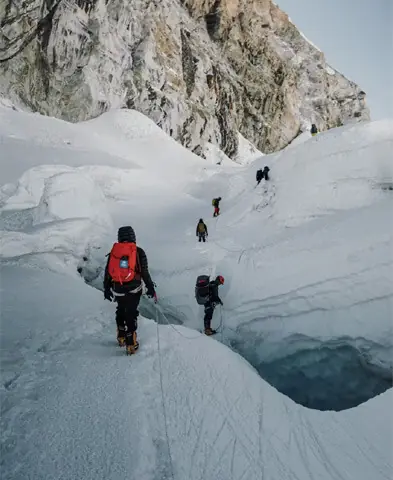
Ali Khurshid takes us on a journey of a different sort. The avid trekker’s love for the North and its nature is apparent in his series of photographs. He captures the mountain peaks and the treacherous terrain from several angles and degrees of proximity. With a focus on the crevices, ridges and slopes, Khurshid displays the elaborate textures speckled with organic mark-making. In some images, the viewer cannot identify if the photograph is of an elevation taken from eye level or an aerial still of an abrasive topography. The apprehension is fuelled further by his clever titles that allude to rivers, cathedrals and volcanic remnants.
Khurshid’s playful process is similar to cloud-watching, where the viewer deceives their mind to read cloud shapes as representational forms. The images look otherworldly and teleport the viewer into a semi-fictional realm. Khurshid manages to depict these gargantuan sculptures as ethereal objects that will visually mutate at their will, which they do, depending on the weather and light conditions.
While the three artists choose to showcase works from their travels that suggest human movement, Humayun Memon situates his series in the premise of his home. He produced the series during the lockdown, where the enforced immobility pushed him to seek subjects of interest without stepping out.
Memon photographed all 27 windows in his house and captured the outside views using infrared photography. This technology requires long exposures where the camera must remain stationary at length, ironically mimicking the long hours we idly spent while restricted to our households.
The photographs resemble thermal imaging and capture the colour range invisible to the human eye. The time we spent looking at our smartphones and laptops instead exponentially increased during the lockdown. Memon realised this and reflected that by presenting diptychs — a photo captured from his window and a pixelated version of the same image that resembles a digital screen. The consequently abstract, expansive colour fields with very few recognisable elements capture the state of not knowing and the uncertainty we experienced for most of last year.
As Memon points out, we are a digital generation that lives on image culture. Visual information saturates our ‘every day’ — Instagram feeds, billboards, Google image results, among others. With this in mind, photography is, arguably, one genre that can be equally exclusive when displayed in museums and galleries, and democratised and made accessible to the larger public. Hence, making photography relevant and indispensable for generations to come.
‘Perspectives’ is on display at the VM Gallery in Karachi from June 14, 2021 to July 05, 2021
Published in Dawn, EOS, July 4th, 2021