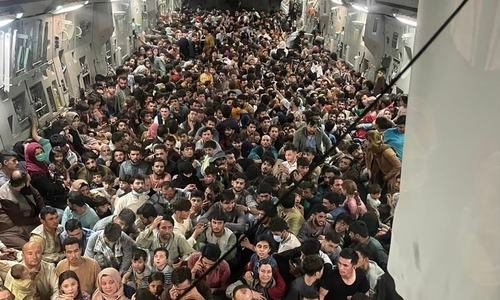
Evacuations from Afghanistan gather momentum as Taliban promise peace


More than 2,200 diplomats and other civilians have been evacuated from Afghanistan on military flights, a Western security official told Reuters on Wednesday, as efforts gathered pace to get people out after the Taliban seized the capital.
The Taliban have said they want peace, will not take revenge against old enemies and would respect the rights of women within the framework of Islamic law. But thousands of Afghans, many of whom helped US-led foreign forces over two decades, are desperate to leave.
"We are continuing at a very fast momentum, logistics show no glitches as of now and we have been able to remove a little over 2,200 diplomatic staff, foreign security staff and Afghans who worked for embassies," the Western security official said.
It was unclear when civilian flights would resume, he said.
The official did not give a breakdown of how many Afghans were among the more than 2,200 people to leave nor was it clear if that tally included more than 600 Afghan men, women and children who flew out on Sunday, crammed into a US military C-17 cargo aircraft.
The Taliban, fighting since their 2001 ouster to expel foreign forces, seized Kabul on Sunday after a lightning offensive as US-led Western forces withdrew under a deal that included a Taliban promise not to attack them as they leave.
US forces running the airport had to stop flights on Monday after thousands of frightened Afghans swamped the facility looking for a flight out. Flights resumed on Tuesday as the situation came under control.
As they consolidated power, the Taliban said one of their leaders and co-founders, Mullah Abdul Ghani Baradar, had returned to Afghanistan for the first time in more than 10 years.
Baradar was arrested in Pakistan in 2010, but released from prison in 2018 at the request of former US president Donald Trump's administration so he could participate in peace talks.
As he was returning, a Taliban spokesman held the movement's first news briefing since their return to Kabul, suggesting they would impose their laws more softly than during their earlier time in power, between 1996-2001.
"We don't want any internal or external enemies," Zabihullah Mujahid, the Taliban's main spokesman, told reporters.
Women would be allowed to work and study and "will be very active in society but within the framework of Islam", he said.
During their rule, also guided by religious law, the Taliban stopped women from working. Girls were not allowed to go to school and women had to wear burqas to go out and then only when accompanied by a male relative.
Ramiz Alakbarov, the UN humanitarian coordinator for Afghanistan, told Reuters in an interview the Taliban had assured the United Nations they can pursue humanitarian work in Afghanistan, which is suffering from a severe drought.
The European Union said it would only cooperate with Taliban authorities if they respected fundamental rights, including those of women.
'Walk the talk'
Within Afghanistan, women expressed scepticism.
Afghan girls' education activist Pashtana Durrani, 23, was wary of Taliban promises. "They have to walk the talk. Right now they are not doing that," she told Reuters.
Several women were ordered to leave their jobs during the Taliban's rapid advance across Afghanistan.
Mujahid said the Taliban would not seek retribution against former soldiers and government officials, and were granting an amnesty for ex-soldiers as well as contractors and translators who worked for international forces.
"Nobody is going to harm you, nobody is going to knock on your doors," he said, adding that there was a "huge difference" between the Taliban now and 20 years ago.
He also said families trying to flee the country at the airport should return home and nothing would happen to them.
Mujahid's conciliatory tone contrasted with comments by Afghan First Vice President Amrullah Saleh, who declared himself the "legitimate caretaker president" after President Ashraf Ghani fled the country, and vowed not to bow to Kabul's new rulers.
Read: Ashraf Ghani fled with cars and helicopter full of cash, says Russia
Saleh appears to have gone underground, and it is unclear how much support he can muster in a country exhausted by decades of conflict.
US President Joe Biden and British Prime Minister Boris Johnson said they had agreed to hold a virtual meeting of Group of Seven leaders next week to discuss a common strategy and approach to Afghanistan.
The decision by Biden, a Democrat, to stick to the withdrawal deal struck last year by his Republican predecessor Trump has stirred widespread criticism at home and among US allies.
Biden said he had to decide between asking US forces to fight endlessly or follow through on Trump's withdrawal deal. He blamed the Taliban takeover on Afghan leaders who fled and the army's unwillingness to fight.