Turning from Afghanistan, US sets focus on China


After two decades of focus on Afghanistan, the US withdrawal this week allows the country to shift its concentration to the east, where superpower rival China is now the top priority.
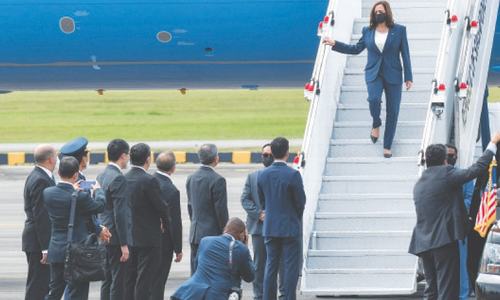
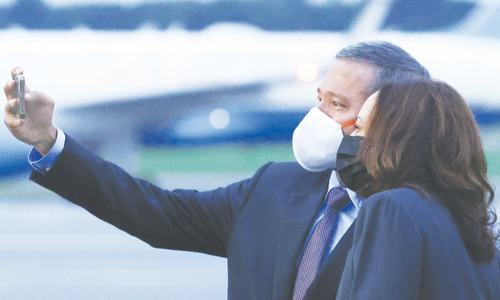
In an indication of Washington's strategic turn, Vice President Kamala Harris was in Southeast Asia last week even as the US pullout from Afghanistan moved into its turbulent final days, hoping to strengthen US allies' pushback against the region's giant.
Harris accused Beijing of “actions that... threaten the rules-based international order,” particularly its aggressive claims of territory in the South China Sea.
Her tour of Singapore and Vietnam was seen as an effort by the administration of President Joe Biden to reassure Asian allies, who were left somewhat disquieted by the US pullout from Kabul after the sudden fall of the Afghan government that Washington had propped up for nearly 20 years.
Ryan Hass, a foreign policy specialist at Brookings Institution, said the debacle of the US pullout from Afghanistan will not have a lasting impact on Washington's credibility in Asia.
“America's standing in Asia is a function of its shared interests with its partners in balancing China's rise and in preserving the long peace that has underpinned the region's rapid development,” Hass said. “None of those factors are diminished by events in Afghanistan."
Washington's turn to East Asia will “open up new opportunities” for the US and its partners in the region, he told AFP.
No encouragement to Russia
Lawmaker Adam Smith, head of the Armed Forces Committee in the House of Representatives, said that the US exit from Afghanistan is not likely to change the balance between the US and rival superpowers Russia and China.
He rejected suggestions on Tuesday that the seeming momentary display of weakness by the Americans could encourage China to invade Taiwan or Russia to attack Ukraine, for example.
“I think anyone who thinks that their [Russia's or China's] calculation has significantly changed because we just pulled the last 2,500 troops out of Afghanistan — I really don't see that,” Smith said during an online Brookings conference.
“There are a lot of other issues that go into whether or not Russia and China are going to feel like they have the ability to be aggressive in those parts of the world,” he said.
Derek Grossman, a former Pentagon official and now a defense expert at the Rand Corporation think tank, said China could seek an advantage in fostering good relations with the Afghan Taliban.
Beijing could decide quickly to recognise the Taliban government, even as Washington and other Western governments hold off as they hope to convince Afghanistan's new rulers to moderate their hardline policies.
“China, as a new great power in competition with the US, probably wants to demonstrate its unique way of handling world events, which tends to be — often reflexively — the opposite of Washington's approach,” Grossman said.
“Recognising Taliban-run Afghanistan would contribute to the perception that it is Beijing, and no longer Washington, that is now setting the agenda and shaping the future regional order,” he said.