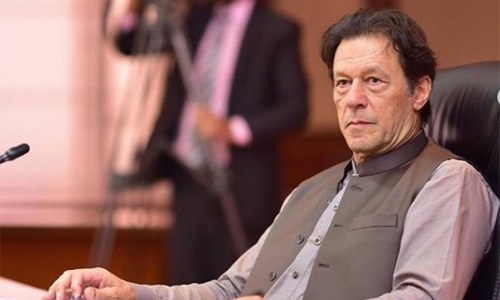
Pakistan concerned about Afghan terror threat: PM Imran


KARACHI: While expressing the desire to promote a comprehensive, not selective, approach to neutralising terrorists’ threats from Afghanistan, Prime Minister Imran Khan has highlighted the need for international community’s cooperation to help in stabilising the country by addressing humanitarian crisis and supporting its economic recovery.
Afghanistan faced a difficult transition from the past 20 years of a US-Nato supported governance structure, PM Khan said in a wide-ranging interview with Newsweek.
Since the Taliban seemed to have gained control over the entire country for the first time, there was a hope that security could be established across Afghanistan, he said. “A peaceful Afghanistan will be beneficial for Pakistan, opening up possibilities for trade and development projects,” he remarked. But Afghanistan faced a humanitarian crisis due to the Covid-19 pandemic, conflict, and failures of the previous governments, which must be addressed as a priority, he said.
“Also, we need to work with the authorities in Kabul to neutralise terrorists’ groups present in Afghanistan, particularly the TTP [Tehreek-i-Taliban Pakistan], which has been responsible for thousands of terrorist attacks against Pakistan,” the prime minister said.
In response to a question, PM Khan said there was indeed a plethora of terrorist groups which, taking advantage of the conflict in Afghanistan, located themselves in that country. Pakistan was extremely concerned about the threat of terrorism from Afghanistan, particularly from the TTP, which had conducted thousands of attacks against Pakistan from the territory of Afghanistan with the sponsorship and support of “certain hostile intelligence agencies”.
The TTP, he said, had also been responsible for most of the attacks on Chinese citizens working in Pakistan, perhaps with the support of the East Turkestan Islamic Movement. Pakistan would work with the authorities in Afghanistan to halt the TTP’s and other terrorism from Afghanistan, he added.
During the Doha peace process, PM Khan recalled, the US established a working relationship with the Taliban. There was direct cooperation between the US and the Taliban during the evacuation process, he said. “I believe that the US can work with a new government in Afghanistan to promote common interests and regional stability.”
He said if China offered economic support to Afghanistan, it was natural that the Afghans would accept it. The Taliban welcomed the prospects of being incorporated in the China-Pakistan Economic Corridor (CPEC) and establishing close relations with China, he added.
PM Khan said the US, too, could play an important and positive role in Afghanistan by providing humanitarian assistance, contributing to Afghanistan’s recovery and reconstruction, and cooperating in containing terrorism from Afghanistan.
Asked if there was concern that Pakistan could be caught up in the broader US-China rivalry, Mr Khan said Pakistan’s relationship with China was 70 years old, covering economic, technological, military and other sectors. Throughout this time, Pakistan simultaneously maintained a close relationship with the US as well. He said it was Pakistan that first brought the US and China together in 1971. “We see no reason for our strategic partnership with China to erode our ability to continue a cooperative relationship with the United States,” he said.
The prime minister believed the current US-China rivalry was “unnecessary and contrary to the interests of both these global powers”. He said cooperation between them would be beneficial to both and was essential to address the myriad problems the world faced — the Covid-19 pandemic, the economic crisis in the developing world and the existential threat of climate change. “We hope that both Beijing and Washington will reach the same conclusion in the near future,” he said.
While rejecting the notion that the US and G7 initiative “Build Back Better World” was in competition with China’s “Belt and Road Initiative”, the prime minister said Pakistan had welcomed the Build Back Better World initiative. He said China had already invested around $25 billion under the umbrella of the CPEC. Additional projects worth $20bn were under implementation, while projects worth a further $25bn were in the pipeline. He expressed the hope that the US and G7 initiative would contribute to building the infrastructure and other projects that were vital to enable developing countries to achieve their objectives, particularly the Sustainable Development Goals. About CPEC projects, he made it clear that the Covid-19 pandemic might have slowed the implementation of some projects, but the objectives were being achieved on schedule, and their implementation would be accelerated in the future.
Published in Dawn, September 25th, 2021