

Afghan dispute overshadows desire for broad-based US-Pakistan ties
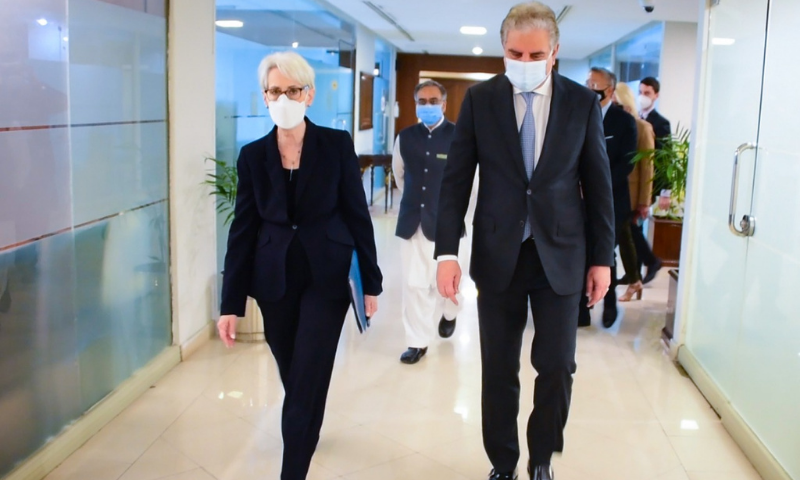

After the latest round of talks in Islamabad on Friday, both the United States and Pakistan expressed their desire for reviving a broad-based relationship, yet both remain focused on Afghanistan.
US Deputy Secretary of State Wendy Sherman arrived in Islamabad on Thursday for the talks that focused on the current situation in Afghanistan and on Washington’s efforts to evolve a coordinated approach towards Kabul’s new Taliban rulers.
The top US diplomat met Foreign Minister Shah Mehmood Qureshi, National Security Adviser Moeed Yusuf and Chief of Army Staff Gen Qamar Javed Bajwa during her two-day stay in the Pakistani capital. She was also expected to meet Prime Minister Imran Khan, but the meeting did not materialise.
On Friday afternoon, the State Department issued two statements on Sherman’s engagements in Islamabad, indicating the centrality of the Afghan issue in US-Pakistan talks.
The department’s spokesperson Ned Price said that in her meeting with Qureshi, Sherman discussed areas of bilateral cooperation, the importance of the US-Pakistan relationship and the way forward in Afghanistan. “Deputy Secretary Sherman emphasised the importance of a coordinated approach to Afghanistan and other issues vital to regional stability,” the statement added.
Another brief statement on Sherman’s meeting with NSA Yusuf said that the two officials “discussed developments in Afghanistan and ways to advance cooperation across the bilateral relationship”.
At a news briefing in Islamabad, Sherman said that while she also discussed bilateral relations with Pakistani officials, “this particular trip was to really consult deeply on how we see the changing circumstances, given the change that has taken place in Afghanistan.”
This confirms what Sherman said at an event in Mumbai on Thursday where she declared that the US no longer sees itself building a “broad-based relationship” with Pakistan and that she was going to Islamabad with a “specific and narrow purpose” of talks on Afghanistan.
Later in a tweet, Sherman did say that she met Qureshi to “discuss Afghanistan’s future” and “the important and long-standing” US-Pakistan relationship. “We look forward to continuing to address pressing regional and global challenges,” she added.
OTH capability for Afghanistan
But Afghanistan remains a factor even in the pursuit for a long-standing partnership with Pakistan, as the US deputy secretary of state said at a news briefing in New Delhi on Wednesday. Speaking to a select group of Indian journalists, Sherman said that the Biden administration was putting together a robust programme for “over-the-horizon” (OTH) capability for Afghanistan.
The top US diplomat, who visited India before coming to Pakistan, did not elaborate this over the horizon capability but a senior US general told a congressional hearing in Washington last week that the United States was holding direct talks with Pakistan over the use of a vital air corridor to Afghanistan.
Gen Frank McKenzie, who heads the US Central Command, expressed the desire for Pakistan’s cooperation at a hearing dominated by demands for punitive actions against Islamabad. The same week, a group of 22 Republican senators also moved a bill in the US Senate, seeking a probe into Islamabad’s alleged role in the Afghan war.
“Over the last 20 years we’ve been able to use what we call the air boulevard to go in over western Pakistan and that’s become something that’s vital to us, as well as certain landlines of communication,” Gen McKenzie said.
Continued engagement
Diplomatic sources in Washington say that despite differences on Afghanistan and other issues, the Biden administration will continue its engagement with Pakistan. According to these sources, future contacts may include the much-desired telephone call from US President Joe Biden to Prime Minister Imran. And there could be more bilateral talks at lower levels as well.
The sources, however, say that in all these talks, the Biden administration will focus on four major points: Recognition of the Taliban government in Kabul, international sanctions on Afghanistan, access to the land-locked country and counter-terrorism cooperation.
Recent statements by senior US officials indicate that the United States does not want Pakistan to recognise the Taliban regime before the rest of the international community does. Instead, it wants Pakistan to continue its efforts for softening the Taliban position on controversial issues, such as inclusive governance, human rights, girls’ education and allowing women to work before extending diplomatic recognition to the regime.
The Americans believe that a change of position on these issues could have a positive impact on the Taliban’s image and pave the way for their acceptance in the United Nations. Individual nations, like Pakistan, should delay their recognition till then.
The United States would also like Pakistan to observe whatever sanctions the United Nations and other world bodies may impose on the Taliban regime.





























