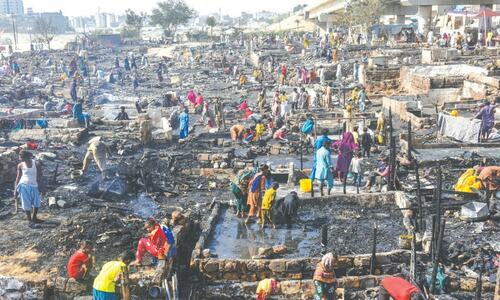
IN recent days, Karachi dwellers have witnessed several incidents of fire. The busy Saddar area experienced major blazes. More than 300 shops and establishments were gutted in one market, reportedly causing a loss of over Rs5 billion. A few days later, another fire broke out at a popular market where more than 100 shops were burnt down. On Nov 20, hutments in the Teen Hatti area were gutted in a fire. Homes made of clothes, reeds, thatch and wood waste were destroyed. For the poor, this incident consumed modest savings of several years. An oil tanker delivering petroleum products to a local fuel station caught fire across a parking plaza. The administration is probing these incidents. But as winter approaches, the possibility of more fires cannot be ruled out.
Conversations with the affected in some cases indicated that mischief was afoot. Karachi has experienced fires which appeared accidental in the beginning but were later found to have been deliberate. The unfortunate Baldia factory fire is a case in point. The perpetrators of such heinous acts either consider law-enforcement agencies to be powerless or find a way to dodge them. Political patronage is another consideration. Ruling political elites tend to give a lot of latitude to gangs that carry out attacks and sabotage.
However, calamities can be triggered by many things, for instance, unsafe methods of storing flammable articles such as textiles and stitched clothing. Meanwhile, electrical and plumbing defects in commercial buildings are seldom repaired and worsen over time. Since owners and managers are only interested in optimising profits, workers are asked to continue without addressing faults such as leakages, sparks in wiring or the malfunction of worn-out conduits. Many premises in commercial as well as residential areas do not even bother to acquire power connections commensurate with the actual load of consumption.
Similarly, layouts and locations of workstations do not guarantee safe evacuation. Having few exits can lead to stampedes and a situation where one is trapped. The lack of ventilation can cause suffocation to those fleeing from the fire. Garment factories, embroidery outlets, stitching shops etc abound in the congested inner city areas and face hazards. Wherever there is a power conduit, gas pipe or cylinder, flammable material, oil depot etc safety precautions are a must.
Read: Factory on fire
Preventing disaster must be a collaborative effort.
The foremost task is to update data pertinent to production, retail and warehousing spaces. The statistics bureau routinely conducts surveys which can serve as a baseline. A municipal project may be formulated to update and enhance this data base. Building information parameters, especially related to human safety, must be included. Our building regulations lay down the basic framework for making provisions for firefighting in building design and maintenance. They envision standpipes, automatic sprinkler systems, manual fire-extinguishing equipment, fire alarm systems, signal stations; overhead water tanks; provisions for fire-resistant construction, the separate provision of fire walls, protected shafts, fire-resistant doors etc. These await strict implementation.
A checklist-based evaluation of existing building stock can help identify inappropriately constructed buildings for the purpose of retrofitting. Specialised teams can be mobilised to design and facilitate these tasks on an urgent basis. Cooperation from all stakeholders is a prerequisite in this endeavour. Trade and commerce bodies, civil society, political parties, building control authorities, labour unions, universities and the media must all work together.
Heterogeneous and complex urban areas like downtown Karachi’s densifying neighbourhoods have many kinds of building stock which need safety and security audits. Warehouse and basic manufacturing activities in the old town quarters, hutments along railway lines, high-tension wires, highways, busy roads, manufacturing units, godowns containing hazardous items, petroleum installations, oil depots, power stations and garbage dumps are some of the sites where people live in a fairly organised but dangerous manner. Various labourers can be spotted sleeping on pushcarts, footpaths and traffic islands, outside shop fronts and boundary walls, in parks and under flyovers. They are all targets of similar hazards.
As has been pointed out, taking preventive steps is better than mopping up after a disaster. The Sindh government must facilitate existing market management committees, shopkeeper associations and local community-based organisations in preparing for more blazes and other hazards. Joint surveys of locations, identification of places where hazardous and flammable material is bought, sold and stored and imparting basic training to volunteers to help them deal with such disasters are all useful measures that could save lives.
The writer is an academic and researcher based in Karachi.
Published in Dawn, November 23rd, 2021