Afghan Taliban reject TTP claim of being a 'branch of IEA'


The Afghan Taliban have distanced themselves from the banned Tehreek-i-Taliban Pakistan (TTP) after the latter recently claimed it was a "branch" of the Islamic Emirate of Afghanistan (IEA) — the regime in charge in Kabul.
TTP chief Mufti Noor Wali Mahsud, in a video available on social media and purportedly shot during his visit to Pakistan's northern areas, had declared that his outfit came under the larger "umbrella" of the IEA.
"Tehreek-i-Taliban Pakistan is a branch of Islamic Emirate of Afghanistan, [and] is a part of that umbrella on this land," Mahsud, flanked by armed TTP fighters, can be seen saying in the video as he addressed a group of men.
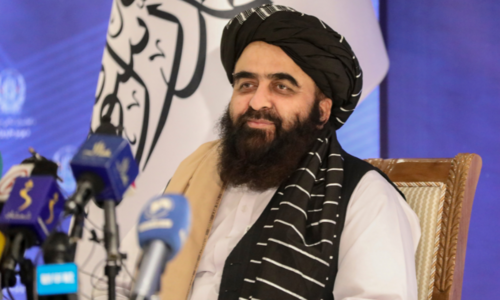
Afghan Taliban spokesperson Zabihullah Mujahid, in an interview with Arab News on Friday, rejected Mahsud's claim of affiliation with the IEA.
"They are not, as an organisation, part of IEA and we don’t share the same objectives,” Mujahid is quoted as saying by the publication.
“We advise TTP to focus on peace and stability in their country. This is very important so they can prevent any chance for enemies to interfere in the region and in Pakistan. And we request Pakistan to look into their demands for the better of the region and Pakistan.”
Mujahid said the TTP was Pakistan's internal matter, adding: "The IEA stance is that we do not interfere in other countries’ affairs. We do not interfere in Pakistan’s affairs.”
Ceasefire — beginning and end
The Afghan Taliban spokesperson's remarks come roughly a month after Afghanistan's acting Foreign Minister Amir Khan Muttaqi acknowledged that the Afghan Taliban were mediating between Pakistan and the TTP on the desire of both the parties.
The Afghan Taliban's facilitation of talks had led to a month-long ceasefire during November, which the TTP declined to extend any further, accusing the government of failing to honour the decisions reached earlier.
A statement issued by the TTP on Thursday gave out details of the six-point agreement that it said it had reached with the government under the aegis of the “Islamic Emirate of Afghanistan” (IEA) on Oct 25, 2021.
The two sides, according to the agreement, had accepted that the IEA would play the role of a mediator and that both sides would form five-member committees each which, under the supervision of the mediator, would discuss the next course of action and demands of each sides.
Both sides, it said, had also agreed to observe a month-long ceasefire from Nov 1 to Nov 30, 2021 and that the government would release 102 “imprisoned mujahideen” and hand them over to the TTP through the “IEA and that both sides would issue a joint statement regarding the ceasefire on Nov 1, 2021”.
According to the statement, the government not only failed to implement the decisions reached between the two sides but on the contrary, the security forces conducted raids in Dera Ismail Khan, Lakki Marwat, Swat, Bajaur, Swabi and North Waziristan and killed and detained militants.
“Under these circumstances, it is not possible to extend the ceasefire,” the TTP said.
The TTP decision to end the ceasefire is a big setback to the government's efforts to secure a peace agreement with the militants waging war against the state for decades.